
UK: Barbary Spurge Hawkmoth, F: Sphinx du Tithymale
Hyles euphorbiae gecki de Freina, 1991, NachrBl. bayer. Ent. 40: 65--72.Type locality: Madeira, 10km east of Funchal.
(Taxonomic notes. (i) Studies of both larvae and adults demonstrate that Hyles euphorbiae gecki is a subspecies of Hyles tithymali (Boisduval, 1834), a view also supported by Meerman (1993), the behavioural studies of Harbich (1994), and the mtDNA studies of Hundsdörfer et al. (2005b). The three worn adults (1 male, 2 females) in the NHMUK (collected by T. V. Wollaston) are referable to Hyles tithymali, a conclusion also reached in part by Baker (1891). Comparison of these specimens and a number of recently reared adults with a large number of Hyles tithymali mauretanica (Staudinger, 1871) indicate that Hyles tithymali gecki is a good subspecies, although some individuals of Hyles tithymali mauretanica do approximate to Hyles tithymali gecki in coloration and pattern. However, the mtDNA work of Hundsdörfer et al. (2005b) indicate that the subspecific status of Hyles tithymali gecki may be in doubt.
The larva of Hyles tithymali gecki closely resembles that of Hyles tithymali mauretanica, differing mainly in having a narrower yellow dorso-lateral stripe and reduced yellow coloration on the prolegs in the final instar, and confirms the placement of this subspecies within Hyles tithymali. This masking of the yellow by black is also found in Hyles tithymali himyarensis Meerman, 1988.
(ii) It should be noted that some populations in northern Portugal and northwestern Spain appear to be hybrids of this subspecies and Hyles euphorbiae euphorbiae (Linnaeus, 1758), similar to those found on Malta (Hundsdörfer, Mende, Harbich, Pittaway & Kitching (2011)). The larvae range in colour and patterning from typical Hyles tithymali gecki to typical Hyles tithymali 'sammuti' Eitschberger, Danner & Surholt, 1998; the adults are very much like Hyles euphorbiae euphorbiae f. vandalusica from southern Portugal and southern Spain [see below for adult and larva], with a touch of tithymali in some. They are thus similar to the adults of the proven hybrid Hyles tithymali 'sammuti', but less red. The settlement and spread pattern of this recent hybrid population indicate landfall along the coast by a few migrant adults (most likely males) riding the prevailing winds from Madeira, and interbreeding with the resident Hyles euphorbiae euphorbiae. However, Gil-T., Requejo & Estévez (2011) dispute this and claim that this 'unknown' population (which has been known about for several years) is a post-ice age relict, giving it the name Hyles tithymali gallaeci. Legs of adults have been sent for mtDNA analysis, which should settle this divergence of opinion. Initial results have already confirmed that the maternal ancestor of the Minho population (Portugal) was Hyles euphorbiae euphorbiae (Hundsdörfer, Mende, Kitching & Cordellier (2011)).)
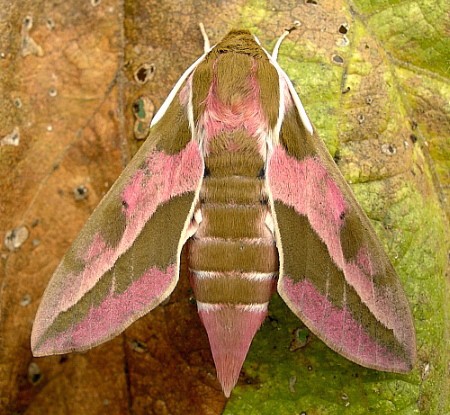
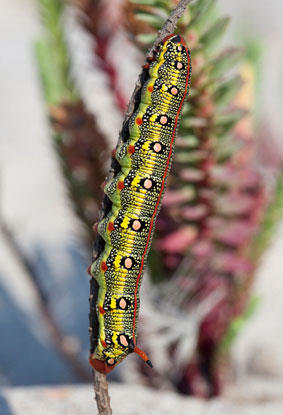
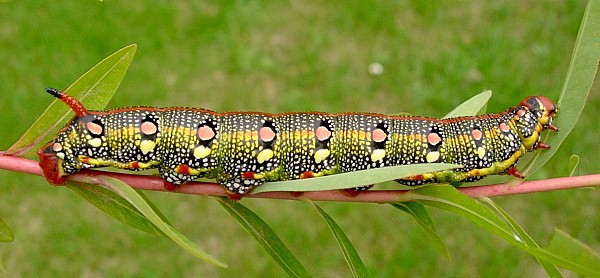
Holarctic; western Palaearctic region. Pleistocene refuge: Monocentric -- Madeira Island (Canary Island subsection of the Mediterranean refuge).
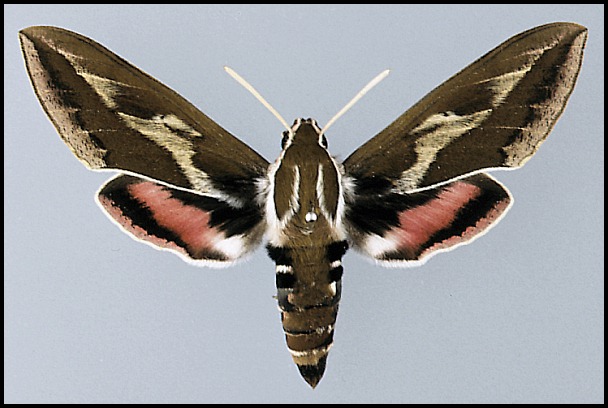
Wingspan: 70--85mm. As illustrated. Similar in coloration and pattern to some individuals of Hyles tithymali mauretanica from Morocco. In some, the normally dark olive brown coloration of the forewing may be reddish brown. The median stripe may also be off-white rather than of the normal pale creamy yellow colour.
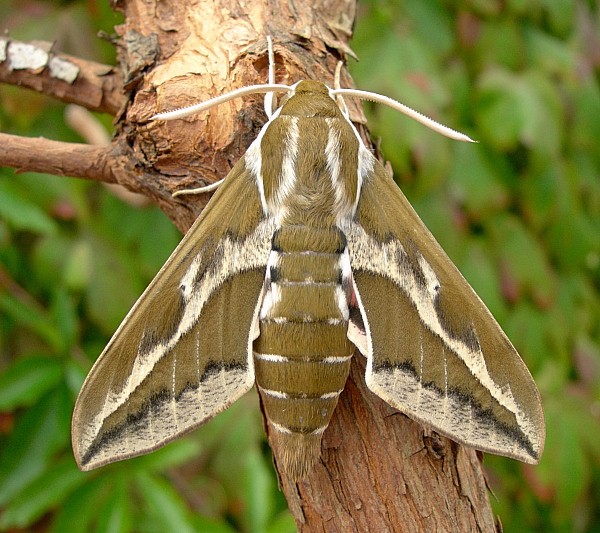
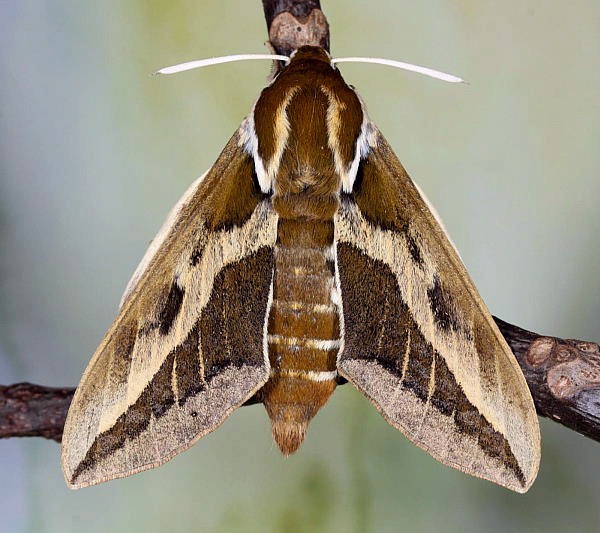
An inhabitant of steep cliffs with a good growth of Euphorbia piscatoria.
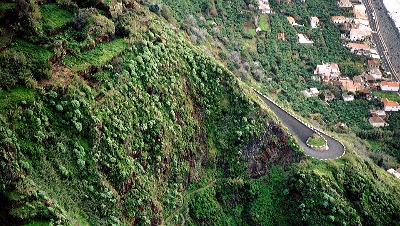
Active well after midnight, with pairing taking place from 02.00 hours onwards (Harbich, 1994), as in other members of the tithymali complex. This is in distinct contrast to Hyles euphorbiae euphorbiae, which tends to pair between 22.00 and 24.00 hours, and in which the males generally become inactive after midnight.
So far as is known, April to October in a number of broods. May be continuous-brooded.
OVUM: Similar to that of subsp. tithymali, i.e. small, very hard and blue-green in colour. Laid in large clusters on the growing tips of the hostplant.
LARVA: Full fed: 75--100mm.
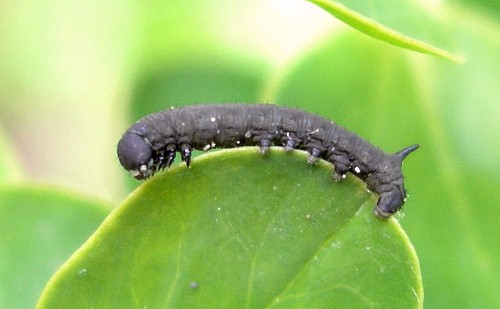
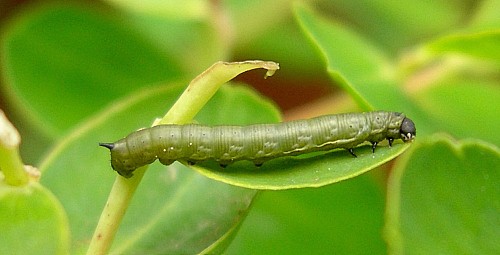
According to de Freina (1991), the young larva is initially matt black, its colour changing with feeding to olive black. In the second instar very similar to that of Hyles tithymali tithymali: ground colour yellow; a dorso-lateral line of round, startling white eye-spots; dorsal and ventro-lateral lines greenish yellow; head dark orange; horn almost matt black. In the third and fourth instars the larva is very similar to that of Hyles tithymali mauretanica. Full-grown larvae are also similar to that subspecies but differ mainly in having a much narrower yellow dorso-lateral stripe and reduced yellow on the prolegs. As in Hyles tithymali tithymali, about 66 per cent of the larvae have a red flush to the normally white eye-spots. (For further information see Harbich, 1994.)
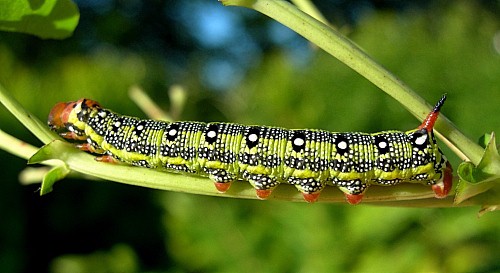
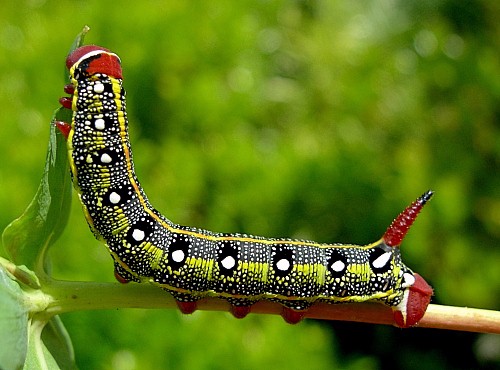
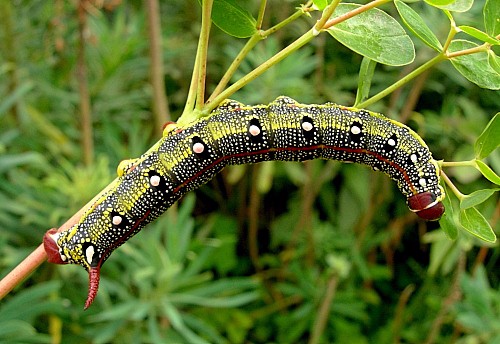
In behaviour very similar to that of Hyles tithymali tithymali but, until the final instar, generally active only by day (de Freina, 1991).
Occurs from April to December.
Hostplant. Euphorbia piscatoria, a plant endemic to Madeira (Aguiar, pers. comm.). Contrary to what is stated in Pittaway (1993) and (Danner, Eitschberger & Surholt, 1998), Euphorbia regis-jubae does not occur naturally on Madeira.
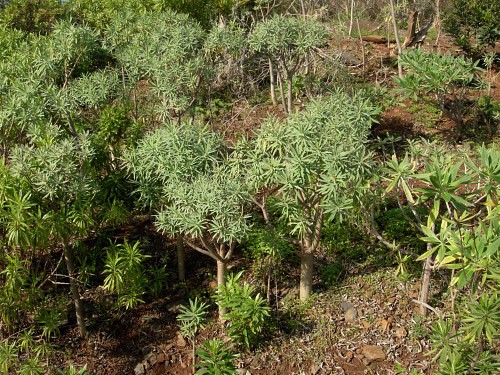
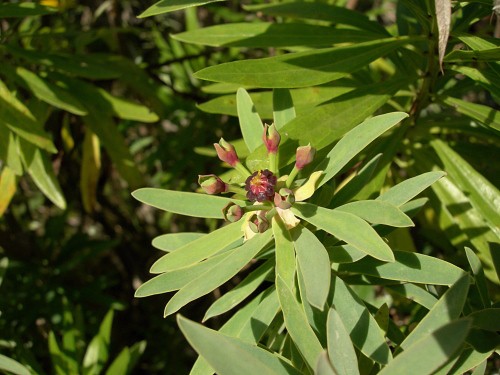
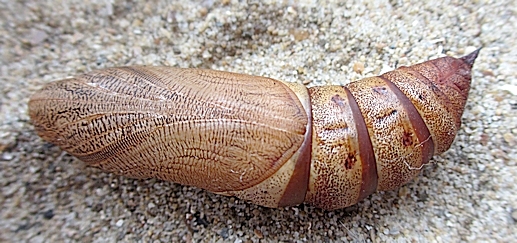
PUPA: Indistinguishable from subsp. tithymali. Overwinters as a pupa. Usually killed by sub-zero temperatures.
None recorded.
Confined to the island of Madeira (de Freina, 1991), where it was also found by M. Geck (pers. comm.), de Worms (1964) and Gardner & Classey (1960), who recorded it as 'Celerio euphorbiae'. Cockerell (1923) noted that there were five species of Sphingidae on Madeira but did not name them.
Extra-limital range. None; however, it should be noted that some populations in northern Portugal and northwestern Spain appear to be hybrids between this subspecies and Hyles euphorbiae euphorbiae.
Return to species list