
UK: Barbary Spurge Hawkmoth, F: Sphinx du Tithymale
Hyles sammuti Eitschberger, Danner & Surholt, 1998, Herbipoliana 4(1): 253.Type locality: Rabat, Malta.
(Taxonomic note. The work of Hundsdörfer, Mende, Kitching & Cordellier (2011) have demonstrated that individuals of Hyles tithymali 'sammuti' from Malta are a mixture of three different lineages. One is closely related to Hyles tithymali (Boisduval, 1834), one to typical Hyles euphorbiae (Linnaeus, 1758), but the third forms a very distinct, older, endemic lineage, which they named 'melitensis' [from the ancient Greek name for the island -- Melite]. This confirms the hypothesis first put forward by Pittaway (1993) that the majority of the present population of the Hyles euphorbiae complex on Malta are of hybrid origin, derived from two young species -- Hyles euphorbiae and Hyles tithymali. However, mixed within this population are the remains of a more ancient, endemic lineage -- 'melitensis', which was absorbed by the newcomers. To quote Hundsdörfer, Mende, Kitching & Cordellier (2011) - 'As the holotype of 'sammuti' carries a mitochondrial haplotype of Hyles euphorbiae, the name 'sammuti' cannot be applied to lineage C ('melitensis'). Furthermore, as two paratypes have the mitochondrial haplotype of a different species, Hyles tithymali, 'sammuti' is clearly indicated as being a taxon of hybrid origin between Hyles euphorbiae and Hyles tithymali.' Thus the taxon 'sammuti' is not valid, but the name is a useful label for the Maltese population.)
[Further details on this taxon, as well as photos of all stages, can be found on Lepiforum.]
Holarctic; western Palaearctic region. Pleistocene refuge: Monocentric -- Malta (Mediterranean refuge).
Wingspan: 63--75mm. Similar in coloration and pattern to some individuals of Hyles tithymali mauretanica (Staudinger, 1871) from Morocco.
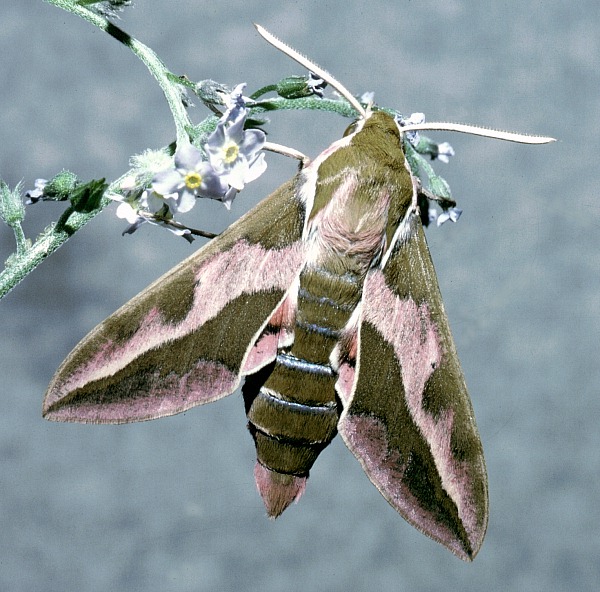
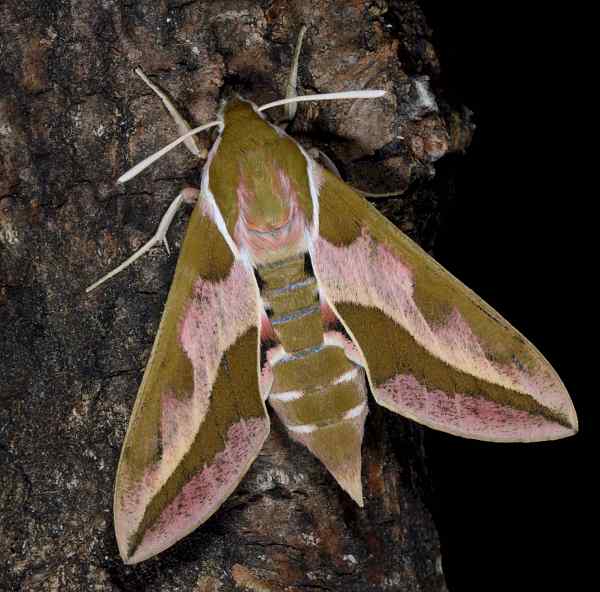
An inhabitant of dry, stony slopes with a good growth of Euphorbia.
February to October in a number of broods. This may be reduced to a single autumn generation in years of low rainfall, but in most years this species is bivoltine, with moths on the wing in April-May and September-October (Valletta, 1973).
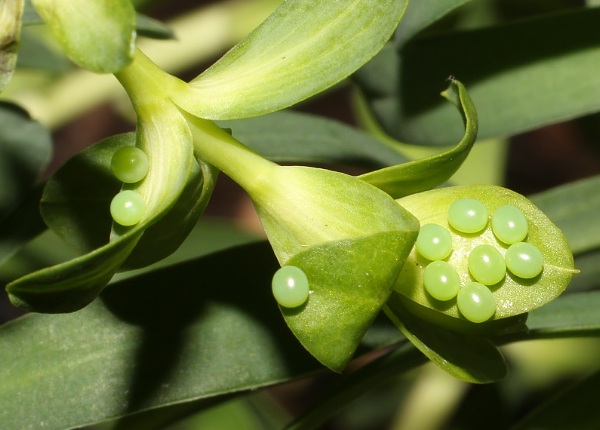
OVUM: Similar to that of Hyles tithymali tithymali, i.e. small, very hard and blue-green in colour. Laid in large clusters on the growing tips of the hostplant.
LARVA: Full fed: 70--80mm. The larva looks very similar to that of Hyles tithymali mauretanica in all its stages; however, in behaviour it is very similar to that of Hyles tithymali tithymali.
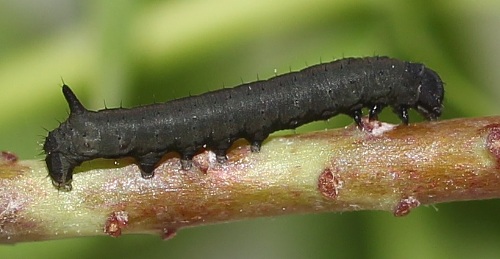
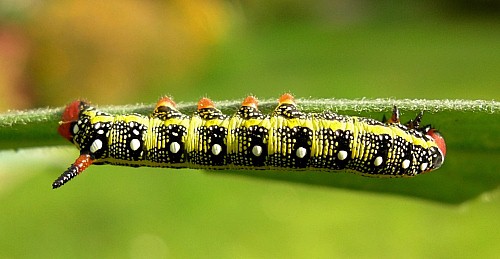
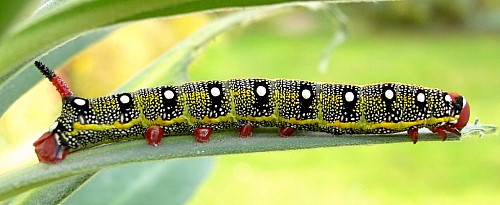
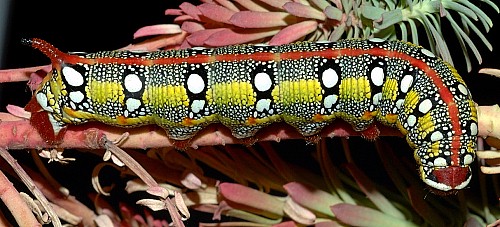
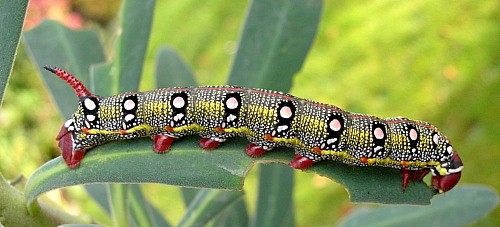
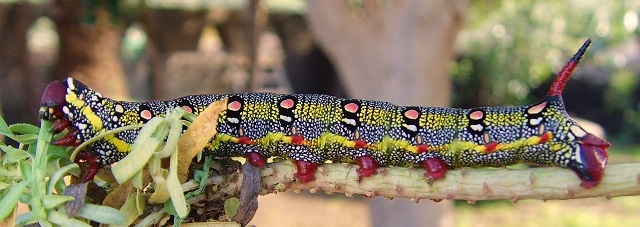
Occurs from March to December in years of good rainfall, but generally commonest from September to December.
Hostplant. Euphorbia spinosa, Euphorbia pinea and Euphorbia dendroides (Valletta, 1973).
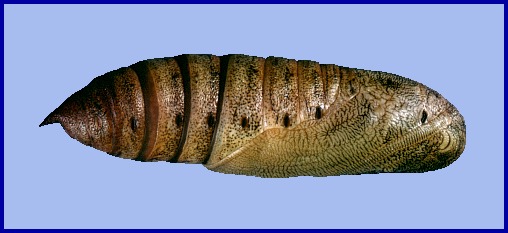
PUPA: Indistinguishable from Hyles tithymali tithymali, but smaller. Overwinters and/or passes the summer as a pupa, often for several seasons.
Valletta (1973) lists Peltocarus dentatus.
Confined to the main island of Malta; not recorded from Gozo.
Extra-limital range. None.
Return to species list