
UK: Barbary Spurge Hawkmoth, F: Sphinx du Tithymale
Deilephila tithymali Boisduval, 1834, Icones hist. Lepid. 2: 30.Type locality: Canary Islands.
(Taxonomic note. The observed genetic admixture between Hyles tithymali and Hyles euphorbiae (Linnaeus, 1758), and the high dispersal potential of the Hyles euphorbiae complex (HEC), lead Mende, Bartel & Hundsdörfer (2016) to postulate a broad trans-Mediterranean 'admixture belt' that repeatedly oscillated north and south with climate changes resulting a mix of expanding and contracting hybrid populations. Indeed, a locally varying interplay of geographic barriers and climate variables, as well as incomplete lineage sorting and introgression, appear to have shaped the truly complex phylogeography of this dispersive hawkmoth species complex. The dynamic effects of this on indentifiable species, subspecies, sibling species, extinction and adsorption has been commented on by Arce-Valdés & Sánchez-Guillén (2022) in this species pair as well as other insects. This, and the work of Hundsdörfer, Lee, Kitching & Mutanen (2019), has highlighted the importance of comprehensive temporal sampling and analyses of multiple markers for a conclusive evaluation of a species' evolutionary history. The data implied that the populations of these two taxa constitute a single gene pool, and thus belong to one biological species (Hundsdörfer, Lee, Kitching & Mutanen, 2019). Nevertheless, a division into two distinct subgroups is very evident based on adult morphology, larval morphology, ecology and biology, so-much-so that for the purposes of this work the HEC subgroups 'tithymali' and 'euphorbiae' are treated as two separate but closely related species which have yet to fully speciate, i.e. they are sibling species.
This conclusion is further supported by a recent phylogenetic reconstruction of the genus Hyles utilizing the extended barcode method. Hyles tithymali, Hyles euphorbiae and the Asian Hyles costata (Nordmann, 1851) cluster together in their own clade, but as distinct and separate entities. In other words, the three taxa are confirmed as distinct but related species within the genus Hyles.)
[Further details on this species, as well as photos of all stages, can be found on Lepiforum.]
Holarctic; western Palaearctic region. Pleistocene refuge: Monocentric -- Canary Island subsection of the Mediterranean refuge. Part of the present day Macronesian faunal element.
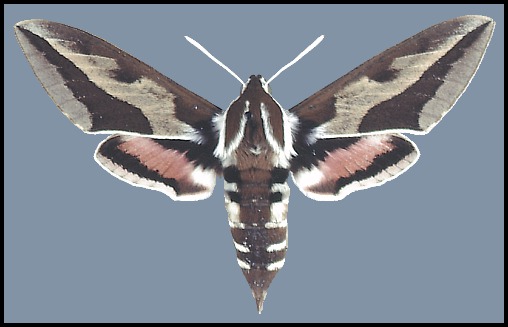
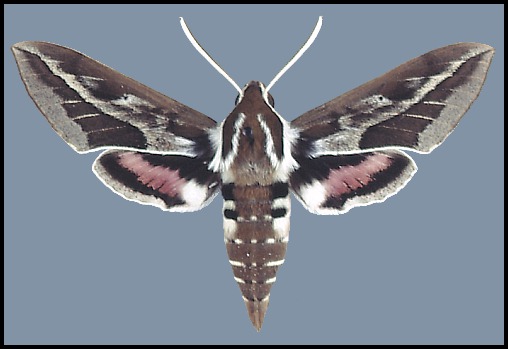
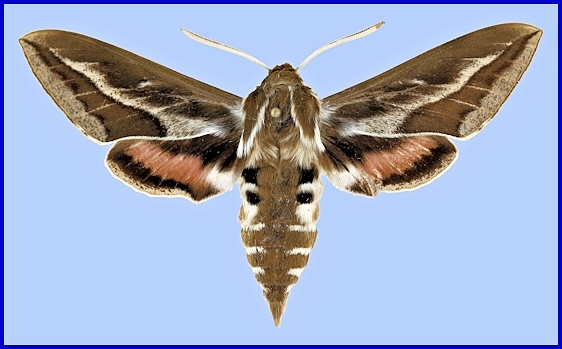
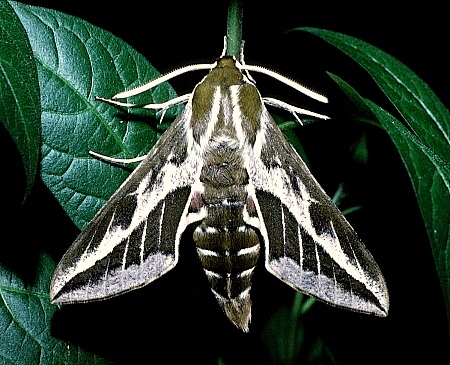
Wingspan: 60--85mm. Many individuals resemble subsp. mauretanica (Staudinger, 1871), with which it undoubtedly shares a common ancestor. Quite distinct from Hyles euphorbiae (Linnaeus, 1758): median stripe of forewing narrow and cream in female, broader and silver in male, many having superimposed silver venation. Not as variable as Hyles euphorbiae.
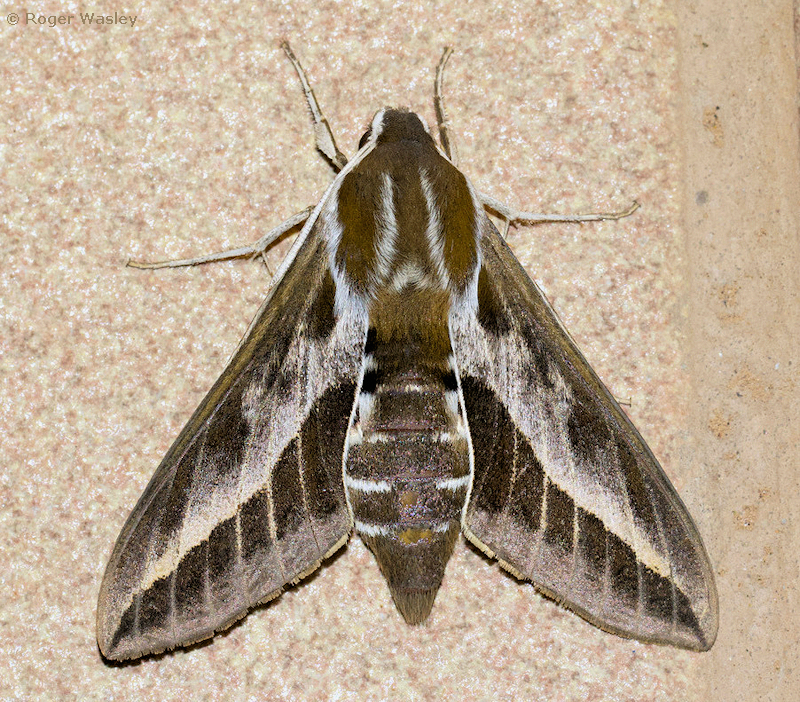
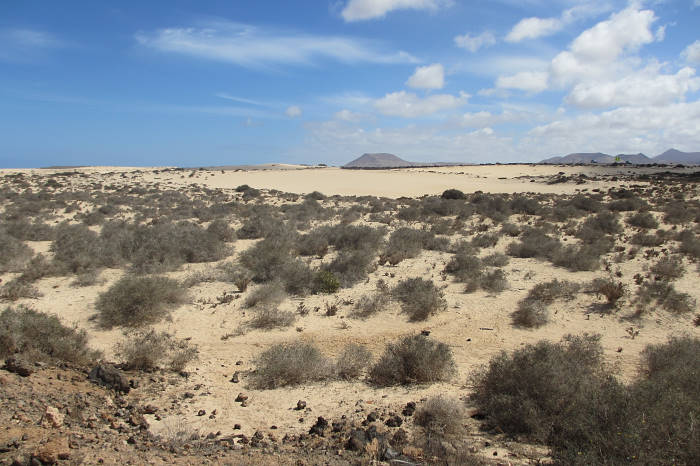
Restricted to the Canary and ?Cape Verde Islands, where it is widespread, occurring from sea-level to 1000m in short-lived but well-defined colonies (Schurian & Grandisch, 1991). Commonest in the drier and warmer parts, such as dry sand dunes, steep-sided valleys (van der Heyden, 1988), and cultivated areas where its main hostplant is most abundant.
Behaviour similar to that of Hyles euphorbiae; attracted to the flowers of Bougainvillea and light (van der Heyden, 1991; 1988). However, unlike for Hyles euphorbiae euphorbiae, this subspecies tends to be active after midnight, with females calling and pairing between 01.30 and 03.00 hours (Harbich, 1994). This pattern of behaviour is also found in Hyles tithymali gecki de Freina, 1991 and Hyles tithymali deserticola (Staudinger, 1901), supporting the amalgamation of these subspecies into a species group distinct from Hyles euphorbiae.
Continuous-brooded throughout the year, although scarce from May to August (van der Heyden, 1990, 1991).
OVUM: Very similar to that of Hyles euphorbiae, but with a noticeable bluish hue. Laid in clusters of up to 25 on the growing tips of smaller hostplants, hatching four to eight days later.
LARVA: Full-fed, 70--80mm. Almost identical to those of subsp. mauretanica and subsp. deserticola.
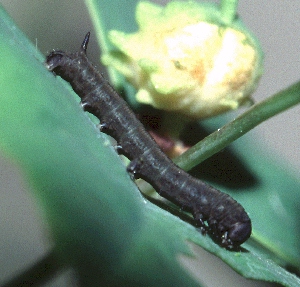
Young larvae are black at first, turning to olive black after feeding, with the final colour pattern appearing in the third or fourth instar. Fully grown, it is quite unlike any colour form of Hyles euphorbiae, more closely resembling certain varieties of Hyles livornica (Esper, 1780). In some individuals, the white eye-spots may be flushed with red.
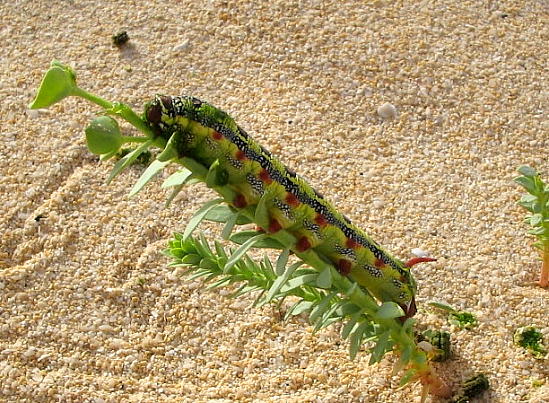
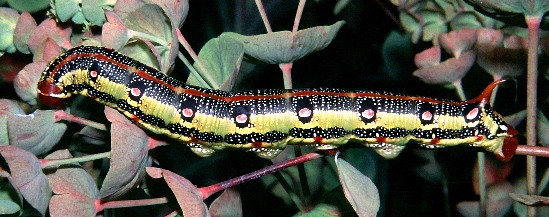
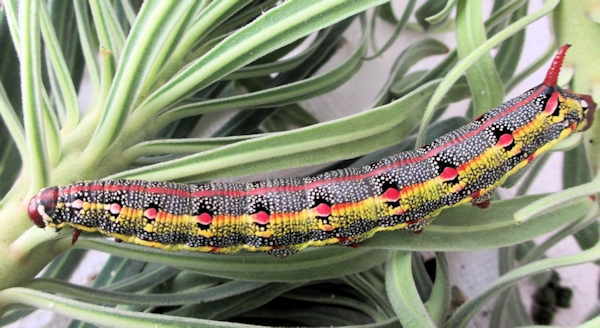
Eggs and small larvae are generally found on small plants of Euphorbia regis-jubae (van der Heyden, 1991). Larger larvae move to and then feed quite openly on the taller, more mature bushes, alternating frenzied bouts of feeding with long stretches of basking (Pittaway, 1976). They may occur in such numbers as to defoliate large areas of hostplant. In midsummer some individuals become fully grown in 20 days.
Being continuous-brooded, various stages of development can be found simultaneously on the same plant, although larvae are scarce from July to October (van der Heyden, 1991).
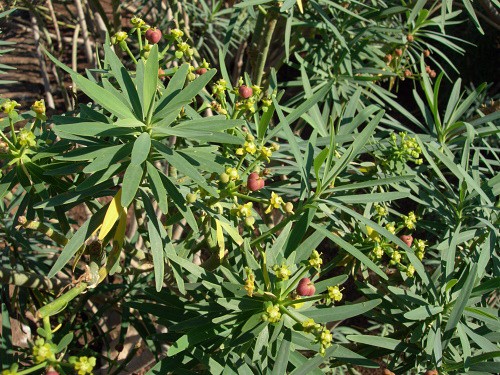
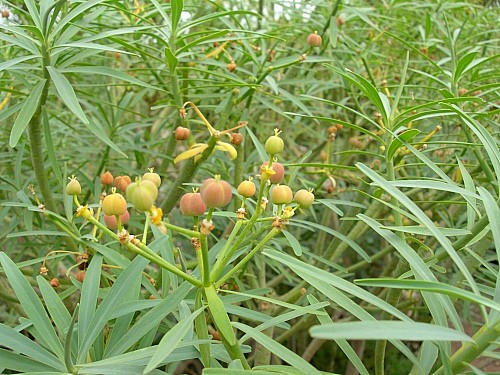
Major Hostplants. The shrubby Euphorbia regis-jubae (van der Heyden, 1988; van der Heyden, 1991; Milbradt, 2017) and Euphorbia lamarckii [syn. Euphorbia broussonetii & Euphorbia obtusifolia]. It should be noted that as Euphorbia regis-jubae is confined to Gran Canaria, Fuerteventura and Lanzarote, Euphorbia lamarckii is utilized on the other islands. Also Euphorbia berthelotii on La Gomera. (The latter is a member of the Euphorbia obtusifolia complex confined to La Gomera.)
Minor Hostplants. Euphorbia paralias (Bacallado-Aránega & Barquín Diez, 1983) & Euphorbia segetalis (Gil-T., pers. comm. 2008).
PUPA: As Hyles euphorbiae, but with many pupae diapausing for two or more years, a characteristic of species adapted to desert conditions. Usually killed by prolonged sub-zero temperatures. Daneck, Barth, Geck & Hundsdörfer (2021) demonstrated higher cold sensitivity in pupae of tithymali populations, which exhibited rather opportunistic and short-termed cold hardiness, while Hyles euphorbiae s. str. produced a phenotype of seasonal cold-hardy diapause pupae under a combined effect of short daylight length and continuous cold treatment.
None recorded.
The eastern Canary Islands of Tenerife (Christ, 1882; Holt-White & Holt-White, 1894), Gran Canaria and Fuerteventura (Milbradt, 2017), as well as Lanzarote (van der Heyden, 1996). Populations from the more western islands of El Hierro and La Palma are of the older, relict subspecies Hyles tithymali phaelipae Gil-T. & Gil-Uceda, 2012 (Gil-T. & Gil-Uceda, 2007; Gil-T., 2010b). The poplulation on La Gomera appears to the result of hybridization between these taxa (Gil-T., 2010a).
Extra-limital range. The Cape Verde Islands off the west coast of Africa (Aurivillius, 1910; Traub & Bauer, 1982; Mück & Traub, 1987; Baliteau & Baliteau, 2011; Tennent & Russell, 2015; Aistleitner, 2022), with larvae common on the endemic Tortolho (Euphorbia tuckeyana Steud. ex. Webb, 1849). However, the exact taxonomic position of this population is uncertain.
Interestingly, Hyles tithymali deserticola has been reported from the island of Fuerteventura, Canary Islands, by Gil-T. (2002) and Eitschberger & Saldaitis (2006). However, the illustration given by the latter is of a pale, desertic ecotype of Hyles tithymali tithymali (Boisduval, 1834), a condition probably caused by feeding on Euphorbia paralias growing on hot, dry sand dunes (Hundsdörfer, Kitching & Wink, 2005a). Additionally, a molecular phylogenetic study of the population places it firmly within Hyles tithymali tithymali (Hundsdörfer, Kitching & Wink, 2005a). Although it may be possible for individuals of Hyles tithymali deserticola to occasionally cross the 100km of water between Morocco and Fuerteventura, there is (as yet) no genetic evidence for this.
Return to species list