
Hyloicus morio Rothschild & Jordan, 1903, Novit. zool. 9 (suppl.): 147. Type locality: Japan.
UK: Asian Pine Hawkmoth; Larch Hawkmoth
Hyloicus pinastri arestus Jordan, 1931, Novit. zool. 36: 244--245.Type locality: Amurland and Ussuri [Russian Far East].
(Taxonomic note. Hyloicus morio is now recognized as a species distinct from Hyloicus pinastri (Linnaeus, 1758), with two subspecies. Subsp. morio Rothschild & Jordan, 1903 inhabits Hokkaido, and central and northern Honshu, Japan (Owada & Kogi, 1992); subsp. arestus Jordan, 1931 occurs from Korea, north-eastern China and the Russian Far East across southern Siberia and Mongolia to the Altai (Owada & Kogi, 1992) and southern Urals in european Russia.
Holarctic; eastern Palaearctic region. Pleistocene refuge: Monocentric -- Manchurian.
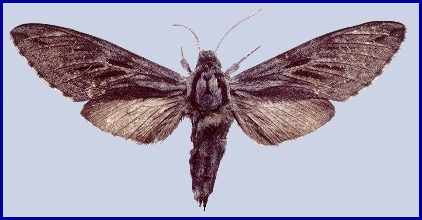
Wingspan: 60--80mm. Very similar to Hyloicus pinastri in external appearence, although many individuals are tinged with reddish-brown. However, the proboscis is only half as long as it is in Hyloicus pinastri (less than 1 cm vs. more than 2 cm in the latter).
In the male genitalia, the upper branch of the sacculus is approximately equal to the lower in length, slightly curved, flattened and broad. This is markedly different from that of Hyloicus pinastri, where the upper branch is long, curved and cylindrical.
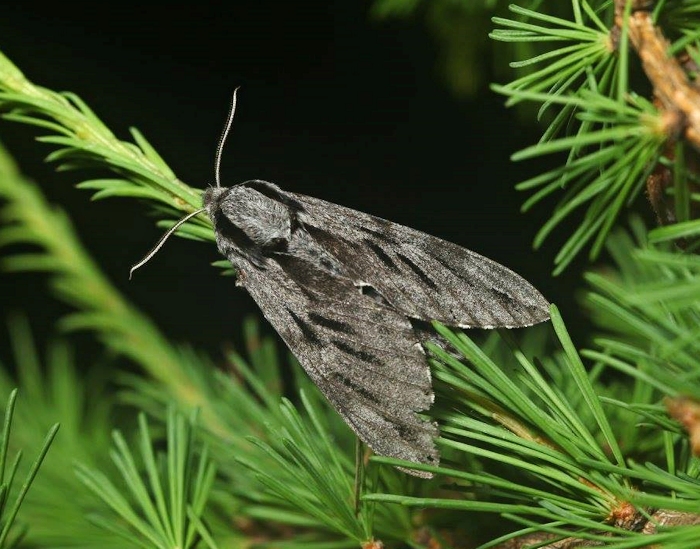
A species of cool larch (Larix) and pine (Pinus) forests.
According to Litvinchuk (1986), Hyloicus morio mates only during the morning. This differs from the behaviour of Hyloicus pinastri and, if confirmed by further studies, may explain how these two species remain reproductively isolated. A similar mechanism keeps Hyles euphorbiae (Linnaeus, 1758) and Hyles tithymali (Boisduval, 1834) isolated. Owada & Kogi (1992) were of the opinion that subsp. morio flies at daybreak in Japan.
Usually univoltine; mid June to late July. Occasionally, there is a partial second generation in August.
OVUM: Oval and slightly dorso-ventrally flattened (2.5 x 1.5mm); shiny pale green at first, changing to reddish yellow. Each female lays between 100 and 120 eggs, which hatch 13--15 days later (Zhao & Zhang, 1992).
LARVA: Full-fed 54--65mm. Dimorphic: predominantly green or brown. Very similar in both appearence and behaviour to Hyloicus pinastri (Linnaeus, 1758).
Fully grown, larvae may be either dark leaf-green with a marked purplish-brown dorsal band bordered on either side with a greyish-white stripe, and two broken cream or white longitudinal lateral stripes (dorso-lateral and ventro-lateral), or mainly greyish-brown. In both colour forms the whole body, which is slender and of even thickness, and blends well with surrounding twigs, has dark, sunken, encircling lines (more evident than in Hyloicus pinastri), apparently dividing it up into narrow rings behind a large, prominent, ochreous-colored, black-lined head and shield. The body is smooth, but not glossy, unlike the head, underside, legs and shield. However, an oily appearance extends over the entire body as the larva darkens prior to pupation.
Mature larvae can easily be told apart from those of Hyloicus pinastri by the well defined dark, purple-brown, dorsal band with its greyish-white edging. This dorsal band is more diffuse and reddish-brown in H. pinastri, and not edged with greyish-white. The basic green body colour of H. morio arestus also has a more emerald hue than that of Hyloicus pinastri. However, both have a thin, slightly curved, black, knobbly horn.
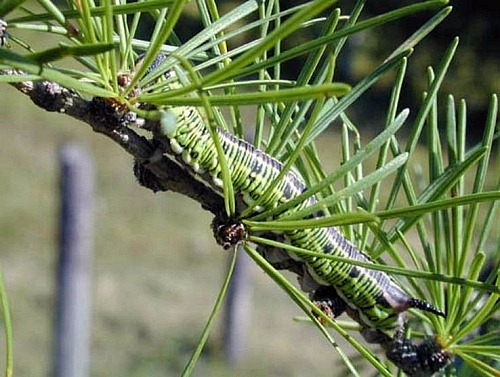
Found mainly during July and August. [All stages are illustrated in Koshkin, 2023]
Hostplants. Various species of Pinus and Larix, particularly Pinus sibirica, Pinus sylvestris, Larix sibirica and Larix gmelinii (syn. Larix dahurica) in Siberia (Zolotarenko, Petrova & Shiryaev, 1978). In the Altai, this species can be a major pest of Pinus sylvestris, sometimes causing complete defoliation of large areas (Plotnikov & Gninenko, 1980).
PUPA: 30--35mm. Very similar to that of Hyloicus pinastri, except that the free tongue-case is replaced by a blunt knob.
None recorded.
In the western palaearctic, confirmed from Chelyabinsk and Krasnoturyinsk in the southern Urals (Ilya Svetlov, iNaturalist 2024) and the Altai Mountains (Plotnikov & Gninenko, 1980; Izerskiy, 1999; Svyatoslav Knyazev, iNaturalist 2022; Knyazev, 2023), as well as western Siberia north to Omsk and Tomsk. Recorded localities are Bazoi, Tomsk, Chingisy, Novosibirsk, Omsk, Kalinovka, Korolevka, Barnaul, Yailyu and Souzga (Zolotarenko, Petrova & Shiryaev, 1978; Knyazev, 2020; Knyazev, 2023).
The distribution of this species now overlaps with that of Hyloicus pinastri in the southern Urals, especially around Chelyabinsk and Yekaterinburg.
Extra-limital range. From the Altai Mountains across southern Siberia and Mongolia to the Russian Far East, north-eastern China and Korea. There is also an isolated population in the Qingling Mountains of Shaanxi Province, China, at around 1500m altitude.
Hokkaido, and central and northern Honshu, Japan, as subsp. morio (Owada & Kogi, 1992).
Return to species list