
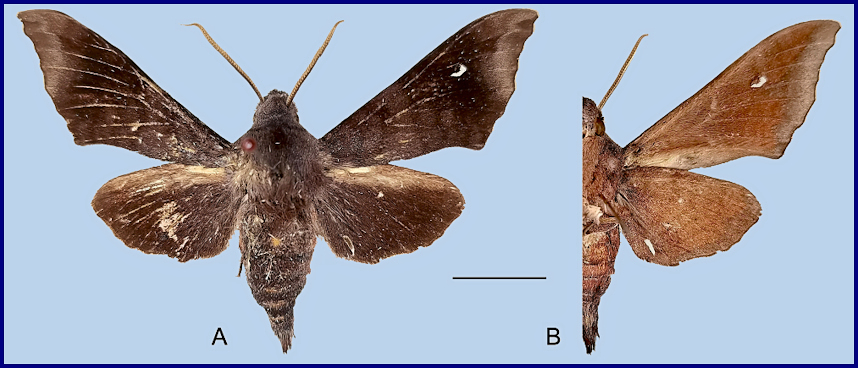
Dahira melichari Haxaire, 2021, European Entomologist, 13(3): 126. Type locality: India, Arunachal Pradesh, road Roing- Hunli, 65 km, 2306m, 9.v.2019.
In the male the head, thorax, and abdomen are dorsally greyish-brown, with a transverse band of black-brown hair; the ventral side is reddish-brown. The forewing upperside is almost uniformly coloured and without patterning, but on this very dark brown background there are six faint transverse lines that cross the wing, three antemedial and three postmedial. The only distinctive mark is a diffuse crescentic and slightly paler area, with a greyish-brown hue, in from the margin, beginning between veins CuA1 and M3 and reaching the apex of the wing. The hindwing upperside is uniformly greyish-brown, lacking the silver stripes and chestnut patch near the tornus found in similar species. The underside of both wings is greyish-brown, brightening slightly from the middle area distad, to become slightly tawny. The marginal band is grey, but poorly delineated basally from the medial area. Both wings are crossed by three thin wavy strips of a reddish colour. The female is unknown (Haxaire, Melichar & Manjunatha, 2021; Jiang, Xu, Lin, Liu, Wang & Hu, 2025).
The male genitalia are very close to those of Dahira haxairei Melichar, 2021 (from Arunachal Pradesh, India). The main differences, as usual, are in the shapes of harpe and the apical plate of the phallus. The harpe is narrow basally, with almost parallel dorsal and ventral margins. The apical hook is very weakly curved and apically rounded. The basal part of the apical plate of the phallus is regularly toothed and smaller than in D. haxairei, but the apical process is totally different, widening into a broadly spatulate and finely toothed structure that is distal rounded (Haxaire, Melichar & Manjunatha, 2021).
In China, only known from the Baoshan, Yunnan, at 2359m.

China: 25.vi.2013 (Baoshan, Yunnan).
OVUM: Unknown.
LARVA: Unknown.
PUPA: Unknown.
Larval hostplants. Unknown.
Unknown.
China: Yunnan (Changning County, Baoshan, 2359m).
So far, only known from northeast India (Arunachal Pradesh) and the Baoshan, Yunnan (China).

Map: Global distribution of Dahira melichari (© Jiang, Xu, Lin, Liu, Wang & Hu, 2025).
Holarctic; eastern Palaearctic region. Pleistocene refuge: Monocentric -- Arunachal Pradesh.
Return to Sphingidae of the Eastern Palaearctic species list