

Acosmeryx formosana arunachalensis Haxaire & Melichar, 2023, European Entomologist, 15: 118. Type locality: India, Arunachal Pradesh, road Roing-Hunli, 28°18'20"N 95°55'17"E, 1983m, v.2019.
Very similar to Acosmeryx formosana formosana, however, the male is larger and with a paler, more greyish coloration. The transverse black-brown band crossing the forewing distal to the discal cell is less prominent. The female is similar to the male, with broader wings and a slightly darker and more extensive ground pattern; antennae noticeably slenderer (Jiang, Xu, Lin, Liu, Wang & Hu, 2025).
The male genitalia very similar to those of the nominotypical subspecies, but distinguished by a sharper and more slender harpe. Additionally, the right process of the transverse apical phallus is noticeably longer and more tapered (Jiang, Xu, Lin, Liu, Wang & Hu, 2025).
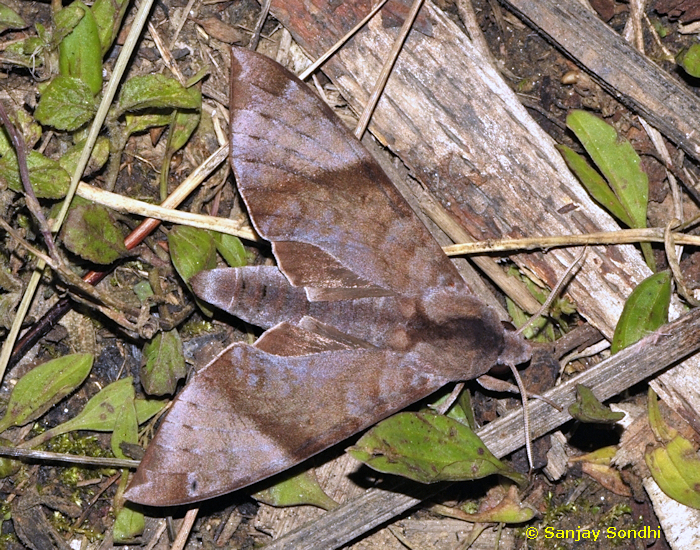
Inhabits middle elevation evergreen broad-leaf forest (Jiang, Xu, Lin, Liu, Wang & Hu, 2025).
China: 6-26.vi (Yunnan).
OVUM: Unknown.
LARVA: Unknown.
PUPA: Unknown.
Larval hostplants. Unknown.
Unknown.
China: Yunnan (Bapo, Dulongjiang, 1312m; Maku, Dulongjiang, 1248-1270m).
Northeast India (Arunachal Pradesh) and southern China (Yunnan).
Map: Global distribution of Acosmeryx formosana arunachalensis (© Jiang, Xu, Lin, Liu, Wang & Hu, 2025).
 Return to Sphingidae of the Eastern Palaearctic species list