
UK: Persian Spurge Hawkmoth
Deilephila robertsi Butler, 1880, Proc. zool. Soc. Lond. 1880: 412.Type locality: Kandahar, Afghanistan.
(Taxonomic note. The eastern populations from the Pamirs, eastern Afghanistan and Kashmir (subsp. orientalis Ebert, 1969 = subsp. elisabethae Ebert, 1996) were once regarded as a separate subspecies of Hyles robertsi, although they now appear to be a mixture of hybrids with Hyles euphorbiae euphorbiae (Linnaeus, 1758).
Based on mtDNA studies (Hundsdörfer, Mende, Kitching & Cordellier, 2011), three robertsi-like individuals from near Esfahan in central Iran, and another from Kaleybar in northern Iran, were found to carry the most common haplotype of Hyles euphorbiae (Linnaeus, 1758). On the basis of adult wing morphology, the moth from Kaleybar was originally determined as Hyles euphorbiae, an identification now confirmed by the sequence data. This demonstrated that Hyles euphorbiae does occur in Iran, contrary to the distribution map in Danner et al. (1998). In contrast, one individual from Lalehzar in southern Iran and three from Natanz and Yazd in central Iran carried a haplotype distinct from that of Hyles euphorbiae. Hundsdörfer, Mende, Kitching & Cordellier (2011) considered that this represented the 'true' Hyles robertsi, although further sampling from central and southern Iran, and southern Afghanistan, is necessary to confirm this.
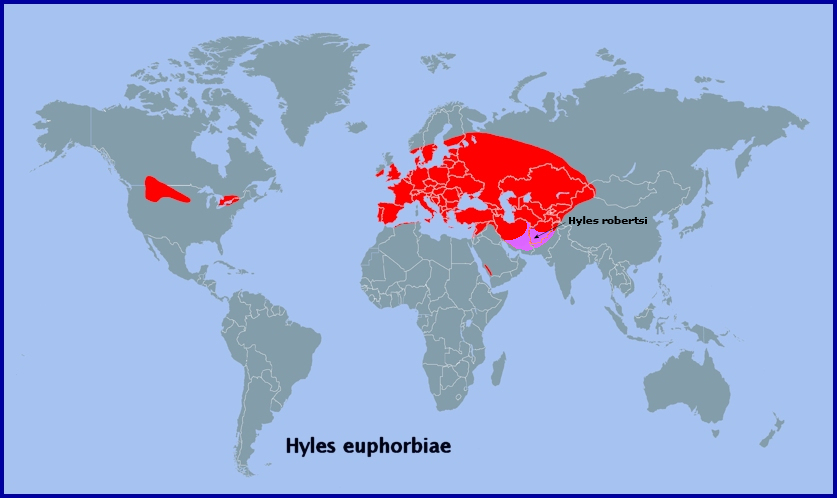
It thus appears that Hyles robertsi may indeed be a good species, but limited to the area south and east of Esfahan, Iran, i.e. southeast Iran, southern Afghanistan and southwestern Pakistan. The populations in northern Iran and southern Turkmenistan appear to be Hyles euphorbiae conspicua, even though many adults look superficially like Hyles robertsi. As mtDNA studies only track the maternal lineage, these populations may eventually be found to represent a hybrid zone. Another hybrid zone may also exist farther south, where Hyles robertsi and Hyles nervosa (Rothschild & Jordan, 1903) meet. Further detailed studies of DNA sequences, adult and immature stage morphology, and biology, are needed to resolve these issues. The work of Hundsdörfer, Mende, Kitching & Cordellier (2011) has started to resolve these contradictions.)
Holarctic; western Palaearctic region. Pleistocene refuge: Monocentric.

![Male Hyles robertsi f. elisabethae (unfaded), Barseen, Indus valley, North-West Frontier Province [Khyber Pakhtunkhwa], Pakistan, 18.iv.1999, 850m. Photo: © Ron Brechlin.](h_rob_a7.jpg "Male Hyles robertsi f. elisabethae (unfaded), Barseen, Indus valley, North-West Frontier Province [Khyber Pakhtunkhwa], Pakistan, 18.iv.1999, 850m. Photo: © Ron Brechlin.")
Wingspan: 65--85mm. Very similar to Hyles euphorbiae conspicua but with narrower, more elongate wings, the forewing bearing a silver-white, oblique median stripe; fringes of the tergites pure white. The veins of the forwings are generally outlined with white distally to a lesser or greater degree, e.g. f. elisabethae Ebert, 1996. Females are often very much larger than the males.

A montane species occurring on dry, rocky slopes with Euphorbia, e.g. open steppe. Behaviour similar to subsp. Hyles euphorbiae conspicua.
End of March to June or later in a number of broods. July has been recorded for Kandahar, Afghanistan (Swinhoe, 1885)
OVUM: Very similar to that of subsp. Hyles euphorbiae euphorbiae.

LARVA: Full-fed, 80--100mm.


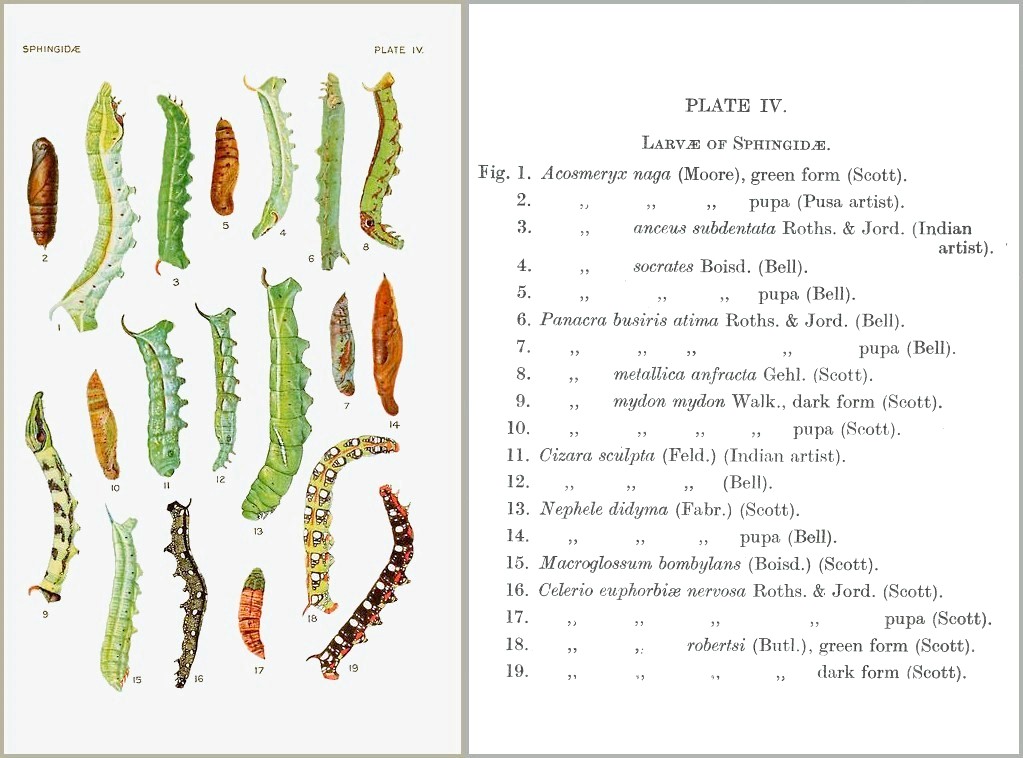
In populations from Yazd Province, Iran (see below), the full-grown larvae tend to be black with small white spots laterally, and bear a prominant dorso-lateral line of large white eye-spots, as well as carmine-red subspiracular blotches. This form conforms to that depicted by Bell & Scott (1937) from Pakistan [PLATE]. Most are of this form and this represents what is normal for 'true' Hyles robertsi, although further sampling from central and southern Iran, southern Afghanistan and Pakistan, is necessary to confirm this. In some the black ground colour can be broken by greenish-yellow patches. This form is also depicted by Bell & Scott (1937).
This black, white and carmine-red (sometimes orange) form is only found in Hyles robertsi and none of the other members of the Hyles euphorbiae complex, and thus its presence is indicative of the identity of this species. It has only been found in southeastern Iran, southern Afghanistan and southwestern Pakistan, as well as northwards up the easten side of Iran as far as Mashhad (Massoud Attarianshandiz, iNaturalist 2022), where it mixes with forms typical of Hyles euphorbiae conspicua.

Hostplants. Herbaceous species of Euphorbia, especially Euphorbia connata in Iran (Daniel, 1971).
PUPA: Similar to Hyles euphorbiae euphorbiae, but more slender and elongate. Overwinters as a pupa.

None recorded.
Iran south and east of Esfahan, i.e. southeastern Iran (Moosa, iNaturalist 2019; Ahmad HB, iNaturalist 2020), and southern Afghanistan and southwestern Pakistan (Bell & Scott, 1937; Tehmoor , iNaturalist 2022). As adults are easily confused with Hyles euphorbiae, Hyles costata (von Nordmann, 1851) and Hyles nervosa (Rothschild & Jordan, 1903), the exact distribution of this species is not fully known.
Records from eastern Kazakhstan, eastern Afghanistan (Swinhoe, 1885), Kyrgyzstan, Tajikistan, northwestern Pakistan (Daniel, 1971; Rafi et al., 2014) and the Pamirs (Ebert, 1969), appear to be a mix of hybrids with Hyles euphorbiae euphorbiae, which has spread down from the north (and not from the west).
[In light of the work of Hundsdörfer, Mende, Kitching & Cordellier (2011), this distribution may have to be revised. [see Taxonomic note above.]]
None.
Return to species list