
UK: Greater Spurge Hawkmoth; Mediterranean Hawkmoth, F: Sphinx Nicéa; Sphinx de Nice; Sphinx de l'Esule, D: Riesenwolfsmilchschwärmer; Großer Wolfsmilchschwärmer, RUS: Nitstskii Brazhnik, H: görög szender, E: esfinge mediterranea, FIN: Välimerenkiitäjä, HR: sredozemni ljiljak.
Deilephila nicaea var. castissima Austaut, 1883, Le Naturaliste 5: 360.Type locality: Sebdou, Algeria.
Holarctic; western Palaearctic region. Pleistocene refuge: Monocentric -- Mauritanian subsection of the Mediterranean refuge.
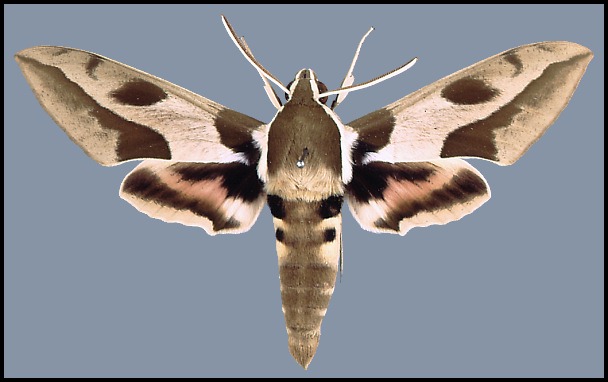
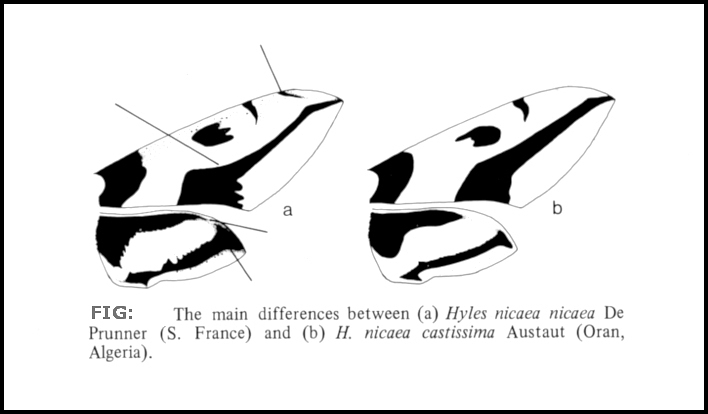
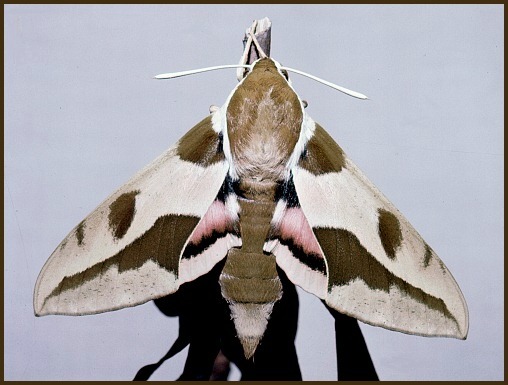
Wingspan: 76--110mm. Similar to subsp. nicaea (de Prunner, 1798) but distal edge of the median band of forewing straight, not bowed as in subsp. nicaea; dark apical streak usually absent. The black post-discal band on the hindwing narrower and separated from the black basal area along the costa, unlike that in subsp. nicaea.
Occurs on dry, stony slopes up to 2000m.
Bivoltine; May/June, and again during late July and August.
OVUM: As for subsp. nicaea.
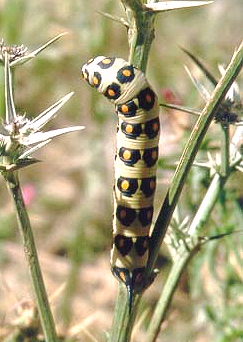
LARVA: As for subsp. nicaea; pale grey to black.
Occurs from June to September in two overlapping generations.
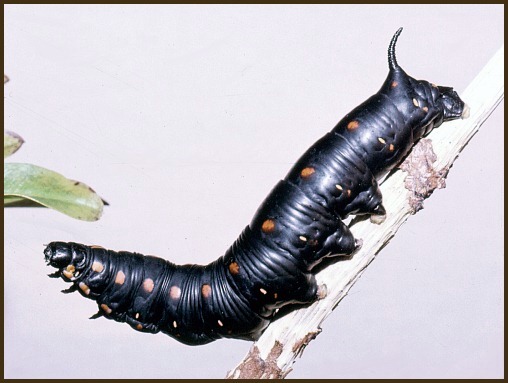
Hostplants. Herbaceous Euphorbia spp., especially Euphorbia nicaeensis.
PUPA: 50mm. Brown to pale buff, with a few fine markings. Otherwise as for subsp. nicaea.
None recorded.
The Atlas mountains in Morocco (Riccardo Panarese, iNaturalist 2018), northern Algeria (Djilali Tahri, iNaturalist 2013) and Tunisia (Oberthür, 1916; Rungs, 1981).
Extra-limital range. None.
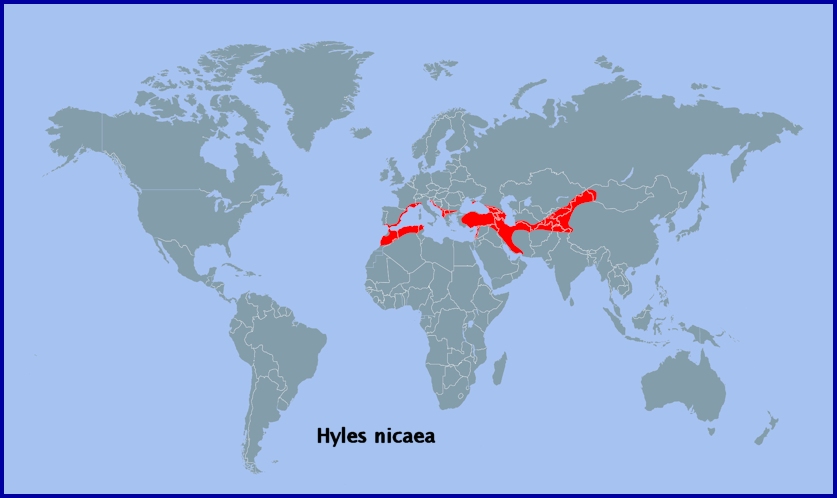
From southern Portugal and Spain across southern Europe to western Turkey (including the Balearic Islands and south-western Bulgaria) as subsp. nicaea (de Prunner, 1798). The southern Crimean Peninsula (Ukraine) and western Transcaucasia as subsp. orientalis (Austaut, 1905). From Lebanon, northern Israel and western Jordan across southern and eastern Turkey, northern Iraq, the northeastern Caucasus, southern Dagestan (Russia), the southern Republic of Georgia, Armenia, Azerbaijan, Iran, Turkmenistan, Uzbekistan, eastern and southern Kazakhstan, Kyrgyzstan, the Pamirs, northern Afghanistan, western Mongolia and western Xinjiang Province, China as subsp. sheljuzkoi (Dublitzky, 1928). Northeastern Afghanistan (Ebert, 1969), northern Pakistan (Rafi et al., 2014), north-west India (Jammu & Kashmir/Ladakh) and China (Xizang Province/Tibet) as subsp. lathyrus (Walker, 1856).
Return to species list