
UK: Seabuckthorn Hawkmoth; Seathorn Hawkmoth, F: Sphinx de l'Argousier, D: Sanddornschwärmer, RUS: Oblepikhovyi Brazhnik; Yuzhnyi Brazhnik, H: déli szender, E: esfinge del espino amarillo, FIN: Tyrnikiitäjä, I: sfinge dell'olivella spinosa, HR: pasjetrni ljiljak.
Deilephila bienerti Staudinger, 1874, Stettin. ent. Ztg 35: 91.Type locality: Shahrud [Imamrud], north-east Iran.
(Taxonomic notes. (i) This subspecies can be very variable in both coloration and size where numerous climatic conditions occur in close proximity to each other, such as in mountainous areas. Many of these forms were described as distinct subspecies but this is not warranted. Subspecies ornatus, transcaucasica, anatolica, bucharana, shugnana, malatiatus, caucasica and baltistana have been synonymized with subsp. bienerti and should be regarded as forms, although there may be some justification in retaining baltistana (semi-isolated in NE Afghanistan, Pakistan and NW India) as a good subspecies. However, Patzold, Marabuto, Daneck, O'Neill, Kitching & Hundsdörfer (2021) found no evidence for a separate mitochondrial lineage in baltistana, nor consistent phenotypic differences, to separate this taxon from Hyles hippophaes bienerti.
(ii) There is now major contact between subsp. Hyles hippophaes hippophaes (Esper, 1789) and subsp. bienerti in the Ukraine, Moldova and Romania, and in western Turkey, to the point where the latter subspecies is replacing the former as it expands westwards (Khalaim, 2022). This has produced intermediate hybrids, such as f. malatiatus Gehlen, 1934a, and f. kiortsii Koutsaftikis, 1974. The Aegean population appears to have originally been subsp. Hyles hippophaes hippophaes, but this is now being swamped by subsp. bienerti as it takes over this area. A few adults of the Crimean population are still intermediate in coloration and pattern between subsp. Hyles hippophaes hippophaes and subsp. bienerti, but nearly all can now be assigned to the latter. With the widespread planting of Elaeagnus angustifolia across southeastern Europe and western Turkey, the previously accepted status quo between the two subspecies is breaking down and is in a rapid state of flux (Khalaim, 2022). As a result of this the population in southern Romania, the type locality of subsp. Hyles hippophaes hippophaes, is being taken over by subsp. bienerti and will be lost in the near future, if this has not already taken place.
(iii) With regard to Hyles chamyla, there is mounting evidence to suggest that Hyles chamyla f. apocyni may be a hybrid between Hyles chamyla and Hyles hippophaes bienerti (Patzold, Marabuto, Daneck, O'Neill, Kitching & Hundsdörfer, 2021). The two taxa appear to form a population group that is in the process of speciation, with ongoing admixture competing against continuous ecological differentiation. However, they did conclude that further research is needed, including of nuclear data, to clarify the origin, development and maintenance of the pattern they found.)
Holarctic; Palaearctic (both eastern and western subregions). Pleistocene refuge: Polycentric -- Caspian, Iranian, Turanoeremic, Turkestan and Mongoloeremic refugia.


Wingspan: 65--80mm. Can be considerably paler and browner than related subspecies. A pale, oblique median line is noticeable on the underside of the forewing; hindwing patches more orange than red. Some large specimens found above 2000m in north-west Iran and Kashmir tend to f. caucasica in coloration.


Often common in mountainous, arid steppe, especially along rivers overgrown with Hippophae or Elaeagnus. Although found at any altitude from 400--3000m, most populations occur from 1000--2000m where Hippophae rhamnoides often forms discrete thickets away from rivers. Attracted to the flowers of Cistanche at dusk (Shchetkin, 1956).

April to September, in two or three overlapping generations.
OVUM: As subsp. Hyles hippophaes hippophaes, with up to 500 being laid by each female.
LARVA: Full-fed, 75--85mm. Dimorphic: unstriped or striped.


The early stages are very similar to subsp. Hyles hippophaes hippophaes. Fully grown, usually also very similar to those of subsp. hippophaes; however, some are dark green with a dorsal lilac tint on the anterior segments and a broken, white ventro-lateral streak. In others, the basic body colour may even be dark grey/black, or even silvery.
This stage lasts as little as 28 days, during which the larva basks quite openly on the topmost branches of its hostplant.
Often abundant from April to August.

Major Hostplants. Hippophae rhamnoides and Elaeagnus spp., especially Elaeagnus angustifolia. It has also been found on Elaeagnus hortensis in Tajikistan (Shchetkin, 1956), and in the Crimea on Elaeagnus argentea (Efetov & Budashkin, 1990).
Minor Hostplants. Possibly species of Daphne (Thymelaeaceae).
PUPA: Similar to subsp. Hyles hippophaes hippophaes; during the summer months it remains in this stage for no more than 20 days. Formed in a chamber in the soil, often up to 10cm deep (Chu & Wang, 1980b). Overwinters as a pupa.
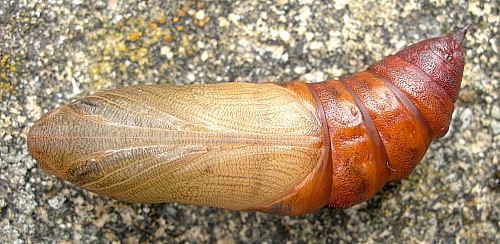


None recorded.
Moldova (Derzhavets, 1984; Tugulea, 2016; Khalaim, 2022), Romania (Esper, [1793]; Székely & Szabó, 1995; Vlad Dinca, pers. comm. 2007; Manci, Sitar, Corduneanu & Balan, 2015; Khalaim, 2022), Bulgaria (Beshkov, 1998; Danner, Eitschberger & Surholt, 1998), northern Greece (Koutsaftikis, 1970; 1973; 1974), the Aegean Islands (de Freina & Piatkowski, 1999), western Turkey (Pittaway, 1982a), central (Rebel, 1933), south-eastern and eastern Turkey (Daniel, 1932; Daniel, 1939; de Freina, 2012; Kemal & Koçak, 2014; Kemal & Koçak, 2016; Koçak & Kemal, 2018), southern Ukraine (Efetov & Budashkin, 1990; Zolotuhin, pers. comm.; Vasilyuk & Inozemtseva, 2003; Khalaim, 2022), the southern Urals to Omsk (Nupponen & Fibiger, 2002; Dubatolov, 2012; Knyazev, 2020), the Caucasus and southern European Russia (Zolotuhin, pers. comm; Poltavsky, pers. comm. 2003; Anikin, 2004), Daghestan, Russia (Yakovlev et al., 2022), the Republic of Georgia (Didmanidze, Petrov & Zolotuhin, 2013), Armenia (Wąsala & Zamorski, 2015) and Azerbaijan (Didmanidze, Petrov & Zolotuhin, 2013; Snegovaya & Petrov, 2021), northern and central Iran (Bienert, 1870; Barou, 1967; Kalali, 1976; Ghassemi, Alemansoor & Alehossein, 2010; Lehmann & Zahiri, 2011), Turkmenistan (Danov & Pereladov, 1985; Toropov, Milko, Zhdanko & Evdoshenko, 2023) and Uzbekistan (Grum-Grshimailo, 1890; Derzhavets, 1984; Toropov, Milko, Zhdanko & Evdoshenko, 2023; Omonov, Rahimov, Askarova & Khomidova, 2023), Tajikistan (Shchetkin, 1956; Toropov, Milko, Zhdanko & Evdoshenko, 2023), eastern Kazakhstan (Kondratiev coll., NHMUK; Shovkoon, 2015; Toropov, Milko, Zhdanko & Evdoshenko, 2023), western Xinjiang Province, China (Pittaway & Kitching, 2000), Afghanistan (Ebert, 1969; Daniel, 1971), northern Pakistan - Gilgit–Baltistan (Khalti Lake, 10.vi.2008), northern Pakistan - Azad Kashmir (Karakoram Mountains, Juglot Valley, 2550m, 26.vii.2011 (leg. Balázs Benedek) (Rafi et al., 2014)), and north-west India - Jammu & Kashmir (O. Bang-Haas, 1939; Sidhu, Nair & Kubendran, 2018) and Himachal Pradesh (Sidhu, Nair & Kubendran, 2018), to the western Tian Shan.
As Elaeagnus angustifolia is widely planted as a hedge and windbreak throughout eastern Europe and Central Asia, this moth has not only expanded its range northwards (Dubatolov, 2012), but also westwards (Khalaim, 2022), and may turn up as a vagrant far from its resident range, e.g. the northern Ukraine (Plyushch & Sheshurak, 1997). In the near future it will probably also reach Hungary, where Elaeagnus angustifolia has become common.
The species only appeared comparatively recently in the Ukraine. In 1954, it was first discovered in the Crimea (Derzhavets, 1984). Later, it expanded its range in the Ukraine, first into the steppe zone and later into the wooded steppe (Plyushch & Sheshurak, 1997; Goloborod'ko, Plyushch & Pakhomov, 2010) (Khalaim, 2022).
Extra-limital range. In China, from Xinjiang Province (China) north to the Altai Mountains (Izerskiy, 1999; Yakovlev, Dubatolov & Titov, 2013) and eastwards across the provinces of Ningxia, Gansu, Shaanxi and Nei Mongol (Inner Mongolia) to Liaoning (Chu & Wang, 1980b; Pittaway & Kitching, 2000), and also Mongolia (Derzhavets, 1977; Yakovlev & Doroshkin, 2017). From these areas north into Russia to Karasuk (Dubatolov, 2012), the Tuva A.S.S.R. (Viidalepp, 1979; Izerskiy, 1999), the Altai Krai (Yakovlev, Dubatolov & Titov, 2013) and Lake Baikal (Kondratiev coll., NHMUK).
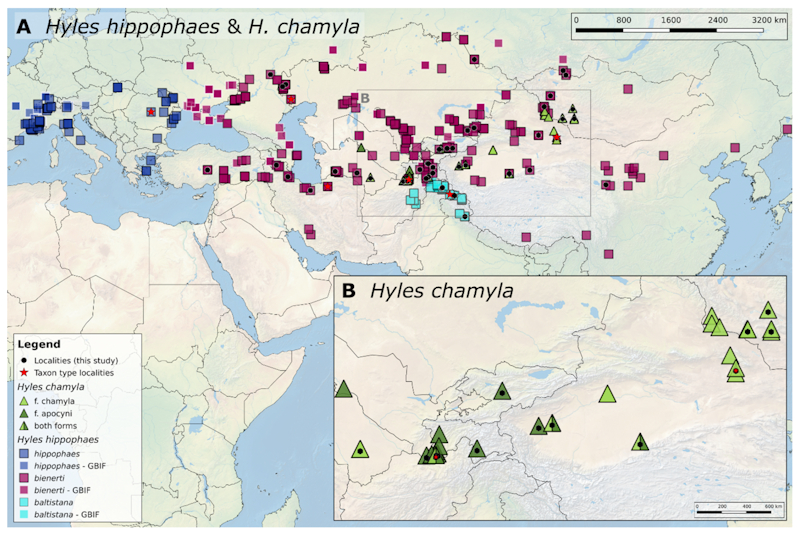
Map: Distribution of Hyles hippophaes and Hyles chamyla in Europe and Asia. Blue of differing shades and magenta squares mark occurrence points of the three infraspecific taxa associated with H. hippophaes; green triangles mark occurrence points for the two H. chamyla forms; black dots indicate genetic samples used in this study; red stars mark the type localities of the taxa; white borders indicate data points derived from GBIF. (© Eduardo Marabuto, in Patzold, Marabuto, Daneck, O'Neill, Kitching & Hundsdoerfer, 2021).
As subsp. Hyles hippophaes hippophaes (Esper, 1789), northern Spain, southern France, southern Switzerland and northern Italy to Slovenia.
Return to species list