
Type species: Actias luna (Linnaeus, 1758).
A Holarctic genus comprising about 18 species, of which two or three occur in North America, one in the western Palaearctic, and the rest in the eastern Palaearctic and Oriental regions.
HOSTPLANT FAMILIES: Many trees and shrubs, with one subgroup specializing in the Pinaceae, particularly members of the genus Pinus.
(Taxonomic note. A in-depth cladistic analysis of the Actias/Argema/Graellsia species group by Ylla, Peigler & Kawahara (2005) initially demonstrated that Graellsia should be retained as a genus separate from Actias. It appeared to be the most basal of this group, being the first species to split off the Actias/Argema evolutionary line. However, a more recent phylomitogenomic analysis by García-Souto et al. (2025) contradicted this finding. It concluded that the Spanish Moon Moth (Graellsia isabellae (Graëlls, 1849)) clustered monophyletically with the Chinese moon moth (Actias dubernardi (Oberthür, 1897)) and the other Oriental pine-feeding species of this genus, supporting the assertion that Graellsia is a junior synonym of Actias.)
UK: Indian Moon Moth; Indian Luna Moth, F: Papillon Lune, D: Indischer Mondspinner, RUS: Pavlinoglazka selena, S: Långsvansad påfågelsspinnare;, NL: Indiase maanvlinder; Maanvlinder, H: Indiai holdasszövő, E: Luna de los actias; Mariposa luna de la India, I: Piccolo pavone di notte; Saturnia minore, N: Indisk månespinner.
Actias selene (Hübner, [1810]), Samml. exot. Schmett. 1: 3, fig. 1.(Taxonomic note. Many of the subspecies assigned to this species in the past have now been given specific status [See notes on distribution for details]. However, whether Actias ningpoana Felder & Felder, 1862 is a good species or merely an ice-age refugial entity/sibling species which took refuge in southeast China, is still open to question. Post glaciation these two 'taxa' appear to have come together again across a broad zone in southern China, with Actias selene having taken refuge in northern India/south east Asia. Such post-glacial zones of secondary contact and hybridization/merger between once isolated sister species are known as suture zones, and have been reported for a variety of taxa in many biomes (Barrowclough et al., 2019; Ipekdal et al., 2020; Moritz et al., 2009; Portnoy & Gold, 2012).)
Type locality: Safed Koh, Sud, Kotkai, eastern Afghanistan.
Holarctic; eastern Palaearctic region. Pleistocene refuge: Monocentric -- Sindian refuge.
Wingspan 116--122mm. Very similar to the nominate taxon, of which it may only be a from, but wings more blue-green with very reduced chocolate and cream eyespots. Body white, banded horizontally with purple-brown in line with the costa, which is of a similar colour. The 60mm hindwing tails are yellowish, with some pink. Males have more falcate wings than females.
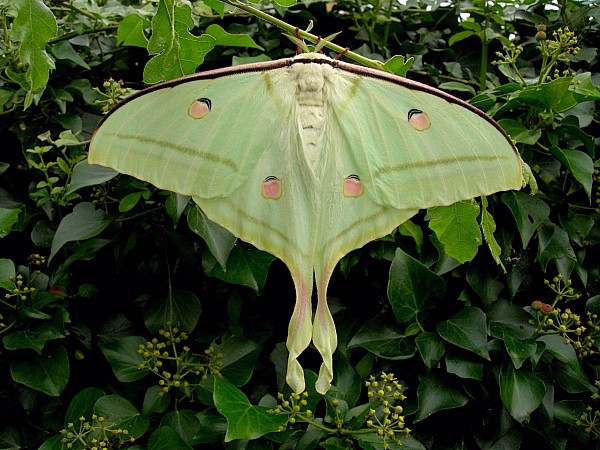
This nocturnal species inhabits open landscapes with scattered trees and shrubs up to 2400m altitude.
Probably univoltine, with adults on the wing from mid to late June (Rougeot, 1969).
Unknown, but probably the same as the nominate subspecies (see Gardiner, 1982 & below images).
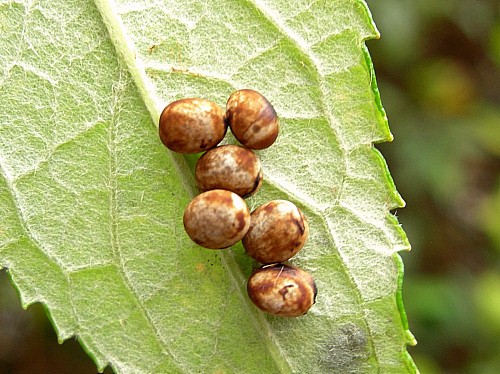
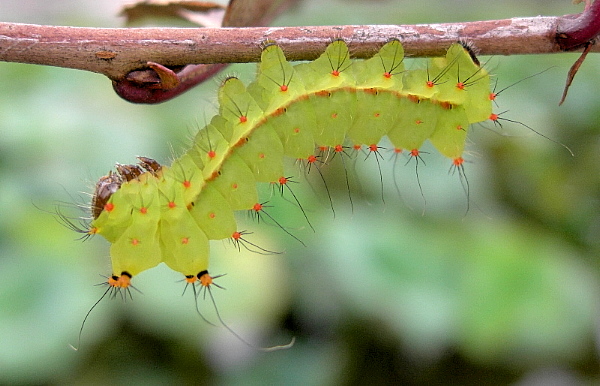
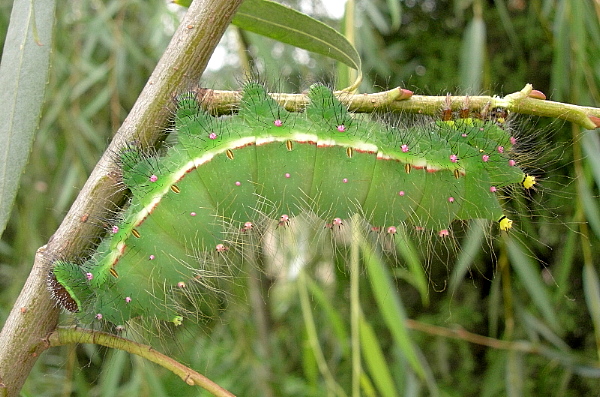
Hostplants. The nominate subspecies feeds on many species of tree and shrubs, and so may subsp. eberti.
Unknown.
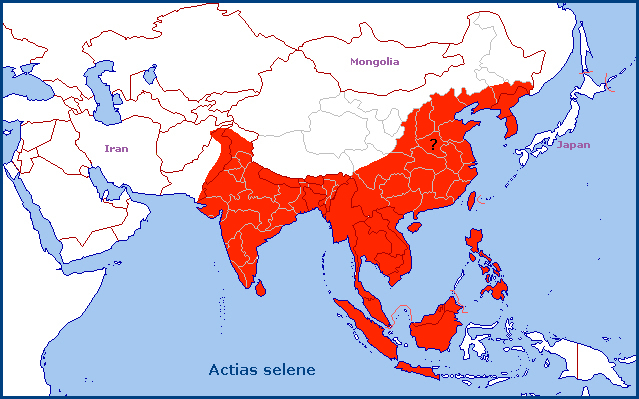
An eastern Palaearctic species which just penetrates the region in eastern Afghanistan, having been found in the Safed Koh mountain range, Nangarhar Province.
Extra-limital range. None.
Only three -- selene (Hübner, [1810]), brevijuxta (Nässig & Treadaway, 1997), and taprobanis U. Paukstadt & L. H. Paukstadt, 1999. These are distributed from Pakistan east to eastern China and Taiwan, and south to the Philippines, Borneo and Sri Lanka.
The situation in China is a little confusing. Although this warmth-loving species is confirmed from the south of the country, it is not known for sure just how far northeast it extends due to confusion with other similar-looking green species. Populations north of Zhejiang Province are probably the Chinese Moon Moth Actias ningpoana Felder & Felder, 1862 [still regarded by many as a subspecies of Actias selene]. Those in Heilongjiang Provice, Korea and the Russian Far East may be Actias dulcinea (Butler, 1881).
The following, formally regarded as subspecies of Actias selene (or Actias artemis (Bremer & Grey, [1851])), are now usually treated as distinct species: Actias ningpoana Felder & Felder, 1862; Actias rhodopneuma (Röber, 1925); Actias laotiana Testout, 1936; Actias felicis (Oberthür, 1896); Actias sinensis (Walker, 1855); Actias distincta (Niepelt, 1932); Actias gnoma (Butler, 1877); Actias chapae Mell, 1950; Actias dubernardi (Oberthür, 1897); Actias appollo Röber, 1923; Actias dulcinea (Butler, 1881); Actias neidhoeferi Ong & Yu, 1968; Actias xenia Jordan, 1911; and Actias aliena (Butler, 1879).
A recent analysis of this group in the Russian Far East is given by Zolotuhin (2011).
Return to species list