
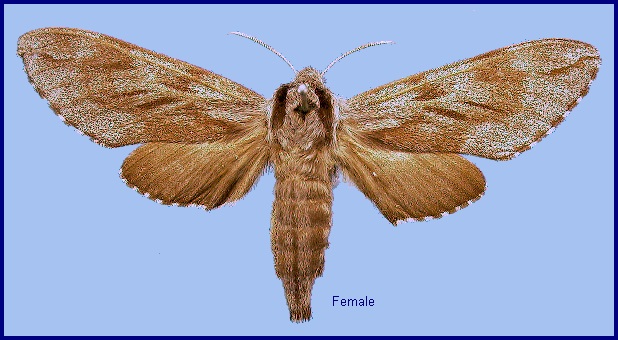
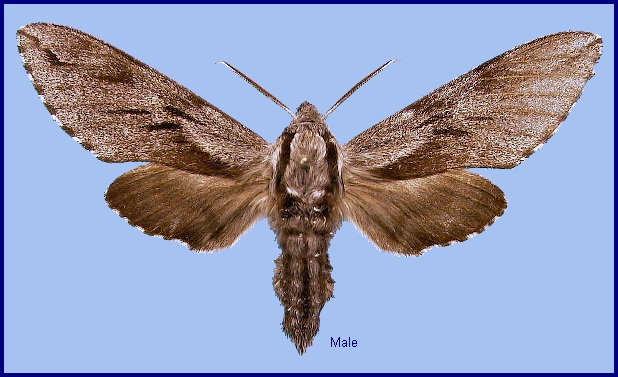
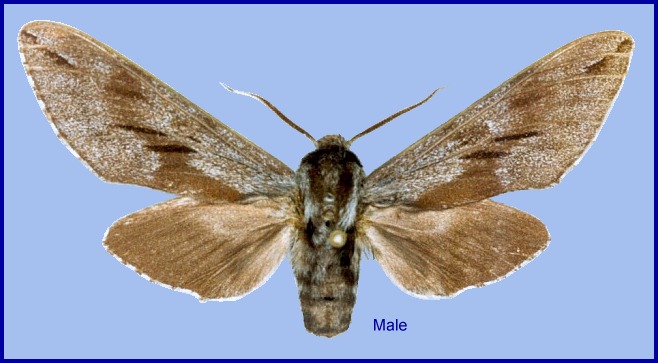
Hyloicus morio Rothschild & Jordan, 1903, Novit. zool. 9 (suppl.): 147. Type locality: Japan.
Synonym. Sphinx morio (Rothschild & Jordan, 1903).
Synonym. Hyloicus morio inouei Owada & Kogi, 1992, Mem. Natn. Sci. Mus., Tokyo (25): 164. Type locality: [Japan,] Hokkaido, Wakkanai, Yuchi, Gosen. Synonymized with the nominotypical subspecies by Zolotuhin & Yevdoshenko (2019), Hawkmoths of Russia and adjacent territories: 13, 120, 438.
Synonym. Sphinx morio inouei (Owada & Kogi, 1992).
Note. Hyloicus morio is now recognized as a species distinct from Hyloicus pinastri, with two subspecies.
[Further details on this species in Japan, as well as photos of many stages, can be found on Digital Moths of Japan.]
Both wings uppersides darker than in Hyloicus pinastri; dark streak behind vein M1, though fainter and less prominent than in Hyloicus morio inouei, not absent or vestigial as in Hyloicus morio arestus; discal cell with stria more prominent than in Hyloicus morio inouei. Hindwing veins Rs and M1 much shorter stalked than in Hyloicus pinastri. Thorax and abdomen uppersides brown. Tegula with black stripe broader than in Hyloicus morio arestus. Abdomen upperside with small pale lateral markings. Pale area of palpus restricted. Proboscis about half the length of that of Hyloicus pinastri.
In the male genitalia, gnathos with lobes broader and shorter than in Hyloicus pinastri. Harpe with dorsal process flattened, not cylindrical as in Hyloicus pinastri, and shorter; the ventral process more horizontal, more curved distally. Phallus with process unlike that of Hyloicus pinastri, short strongly curved apically, pointed.
Individuals from Hokkaido are generally smaller (Owada & Kogi, 1992).
Associated with mixed montane forests dominated by Larix kaempferi, where it appears to fly at daybreak (Owada & Kogi, 1992). Attracted to light-traps.
Japan: 23.vi (Hokkaido); 3.viii (Hokkaido); 19.v-26.viii (Honshu).
OVUM:
LARVA:
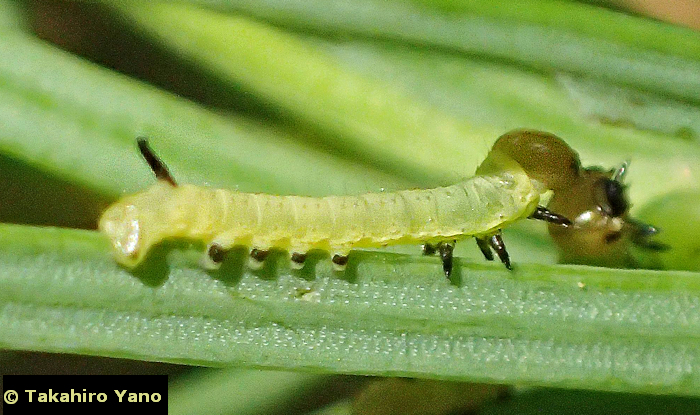
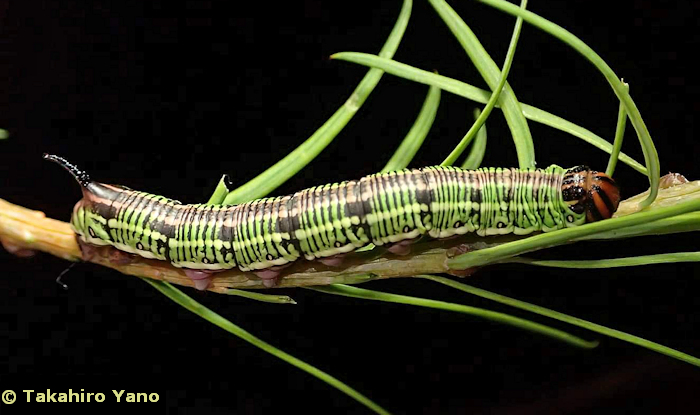
PUPA:
Larval hostplants. Larix kaempferi (Funakoshi, 1986).
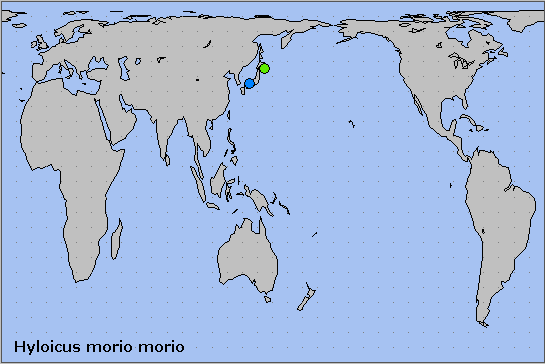
Japan: Hokkaido (Gosen, 60m); Honshu (central and northeastern areas only (Owada & Kogi, 1992), including Tateshina; Kamikochi; Kisojihara, 1200m; Kisojima, 1200m; Mount Fuji, 2370m; Jizo-toge Pass; Doai-guchi; Nikko; Inawashiro; Onikobe; Takayama; Norikura Kogen, 1500m; Tobira Spa; Yumata)).
Endemic to Hokkaido and Honshu, Japan. Records from elsewhere are the result of misidentifications.
Hyloicus morio morio inhabits Hokkaido, and central and northern Honshu, Japan (Owada & Kogi, 1992); subsp. arestus Jordan, 1931 occurs from Korea, north-eastern China and the Russian Far East across southern Siberia and Mongolia to the Altai (Owada & Kogi, 1992).
 Return to Sphingidae of the Eastern Palaearctic species list