
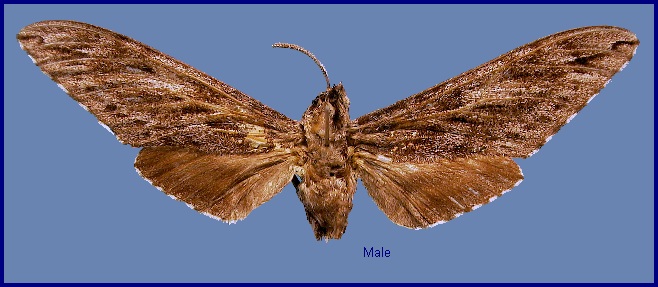
Sphinx formosana Riotte, 1970, Ent. Z., Frankf. a.M. 80: 14. Type locality: Central Formosa [Taiwan, Nantou Hsien], Wushai [Jenai].
Wingspan: 68--75mm. A close relative of Hyloicus crassistriga Rothschild & Jordan, 1903 from Japan, but wings much narrower, forewing with apex slightly falcate, hindwing with apex pointed. Forewings with a general dusting of pale grey scales over the upperside; however, in collections these grey scales fade to brown with age.
Male genitalia similar to those of Hyloicus crassistriga, but valve more robust; harpe with outer margin dentate at dorsal half, ventral edge more produced; saccus longer; sacculus characteristically with a strongly toothed outer edge; phallus sigmoidal, ending in a curved point and with a subapical lateral convexity.
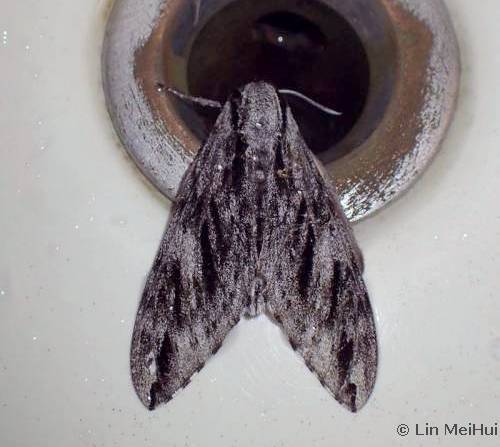
A montane species, occurring above 2000m altitude.
Taiwan: vi (Nantou Hsien; Taichung Hsien); 2.vii (Yilan Hsien); 4.vii.2018 (Chiayi Hsien).
OVUM: Unknown.
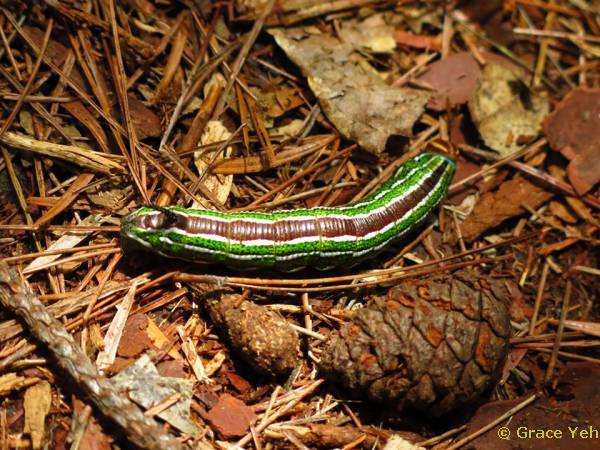
LARVA: Body apple-green, with three longitudinal white lines per side. The dorso-lateral and ventro-lateral edged with black above, the dorsal pair bordering a dark mahogany-brown dorsal band. The green areas and anal flap/claspers with fine black tubercles. Horn black, thin, slightly curved and tubercled. Head oval, light mahogany brown with yellow cheek stripes, which are bordered in front with darker brown.
PUPA: Unknown.
Larval hostplants. Unknown.
Unknown.
Taiwan: Nantou Hsien (Jenai); Yilan Hsien (Taipingshan; Datong township, 2621m); Taichung Hsien (Tashiiehshan, Anmashan, 2230m; Heping District, Malun Shan, 2080m; Heping District, Qika Villa, 2524m); Chiayi Hsien (Alishan Township, Alishan Forest Recreation Area, 2178m).
Endemic to the northern central mountains of Taiwan.
Part of the relict eastern Palaearctic fauna of montane Taiwan. Closely related species are found in Japan (Hyloicus crassistriga Rothschild & Jordan, 1903) and southwest mainland China (Hyloicus centrosinaria (Kitching & Jin, 1998)).
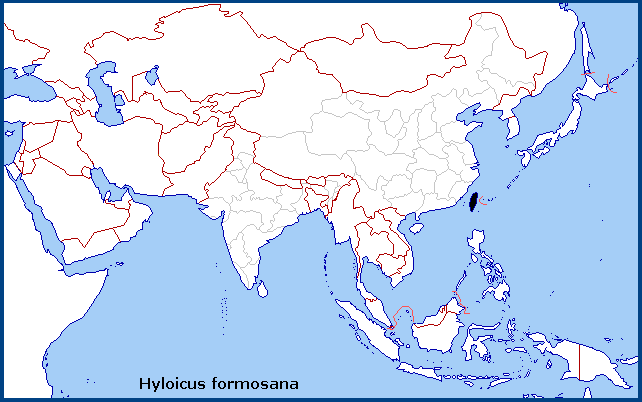
Holarctic; eastern Palaearctic region. Pleistocene refuge: Monocentric -- Taiwan refugium.
Return to Sphingidae of the Eastern Palaearctic species list