
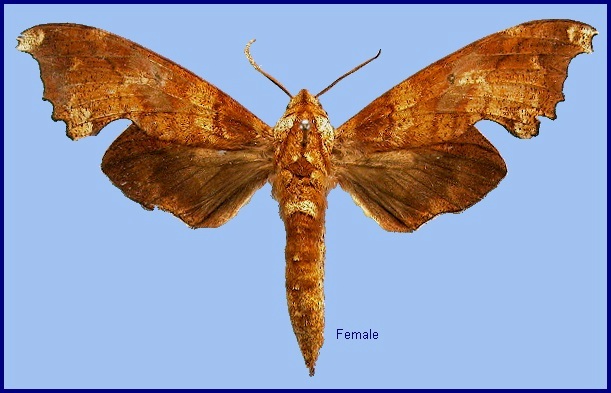
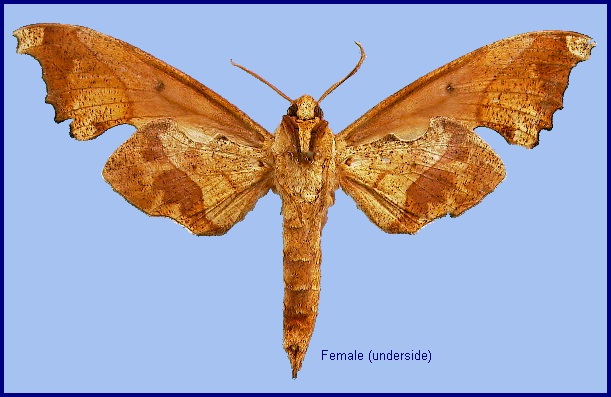
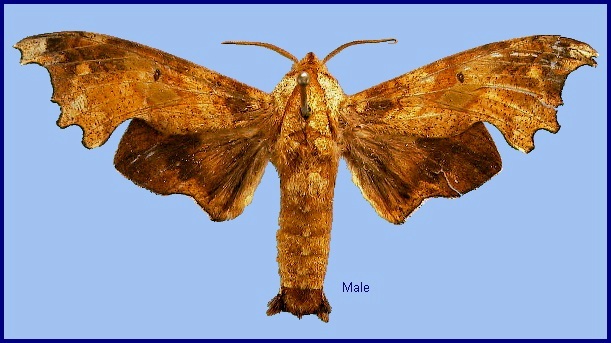
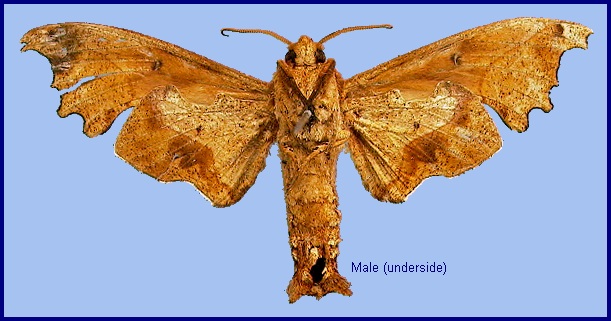
Cypa mirabilis Rothschild, 1894, Novit. zool. 1: 664. Type locality: [India, Meghalaya,] Khasia Hills [Khasi Hills].
Synonym. Cypa mirabilis Rothschild, 1894.
Synonym. Degmaptera mirabilis (Rothschild, 1894).
Note. Rothschild & Jordan (1903) distinguished Degmaptera from Smerinthulus (in which they also included what are now classified as Cypoides chinensis and Morwennius decoratus) solely by 'the hindwing being produced frontad near apex into a rounded lobe, the costal margin more or less sinuate proximally of this lobe, vein C [the costa] almost following the curve of this lobe, not straight as in Cypa and Smerinthulus'. However, a strongly developed lobe is only found in male Degmaptera mirabilis; that of the female is much less curved, and the costal margin of both sexes in Degmaptera olivacea is almost straight. On the basis of similarities in habitus, male genitalia and DNA barcode sequences, Brechlin (2014) transferred Degmaptera cadioui, Degmaptera laotiana and Degmaptera olivacea to Smerinthulus, leaving only the type species, Degmaptera mirabilis and the closely related Degmaptera schnitzleri in Degmaptera. However, using the same reasoning, there was no reason for not transferring Degmaptera mirabilis and Degmaptera schnitzleri as well, and synonymizing Degmaptera with Smerinthulus.
Thus Degmaptera was transferred to Smerinthulus by Brechlin, 2016, Entomo-Satsphingia, 9(4): 87. Then the now Smerinthulus schnitzleri was synonymized with Smerinthulus mirabilis as a subspecies by Haxaire, Melichar, Kitching & Brechlin, 2022, European Entomologist, 14(1+2): 14.
Note. The taxonomic situation of the various subspecies of Smerinthulus mirabilis is problematic. As this moth flies only at elevations exceeding 1000 meters, it is likely that isolated populations are found in all mountain ranges in Southeast Asia and southern China. These populations are all likely to be slightly different genetically. Thus, with the intensification of collecting, there is the possibility of creating different subspecies for each mountain range, or even on each mountain if the genetic (and morphological) interpretations are pushed too far, and if limits are not defined. Hence Haxaire, Melichar, Kitching & Brechlin, 2022, viewed the various subspecies, whose genital morphologies are otherwise identical and whose appearances are extremely similar, with a considerable degree of scepticism. When one must look at the origin of a specimen to give it a name, then there is an obvious problem. Nevertheless, for the time being, they maintained the various entities as subspecies.
The populations from northeastern Myanmar, northern Thailand, northern Laos, western Guangxi and southern Yunnan (China), and northern Vietnam, all appear to be subsp. tonkiniana (Brechlin, 2014) and not subsp. orientosinica. Individuals from Chongqing and Sichuan, China, appear to be subsp. orientosinica and not subsp. mirabilis (Zhuo-Heng Jiang, pers. comm. 2024).

FIG: The various subspecies of Smerinthulus mirabilis in Asia. (A) S. m. mirabilis, Nyingchi/Linzhi, Xizang/Tibet; (B) S. m. tonkiniana, Xishuangbanna, Yunnan; (C) S. m. orientosinica, Longyan, Fujian; (D) S. m. schnitzleri, Nantou Hsien, Taiwan. Scale bar = 10 mm. (© Jiang, Xu, Lin, Liu, Wang & Hu, 2025).
Wingspan: 44--82mm. Forewing upperside deep ferruginous-red, variegated with ochreous and orange-yellow, with a fawn-colored band just beyond the cell; discal spot black with a minute transparent centre. Hindwing deep reddish-brown, with traces of red median and submarginal bands. Costal edge excavated resulting in a conspicuous subapical lobe, which projects anteriorly, as in Smerinthulus olivacea. Abdomen upperside with a central row of pale golden dots.
In the male genitalia, uncus very broad, apex emarginated to form a pair of lobes, each lobe produced into a sharp, ventrally curved hook. Gnathos absent. Socii present as rounded, setose lobes. Valve widest subdistally, dorsal margin thickened and bent inwards, with a long sharp spine projecting from beneath it; apex produced into a hook, which bears a tooth; two small teeth at dorsal apical edge of valva. Harpe in the form of a ventral, elongated upcurved sclerite. Phallus lacking armature.
The moth rests with the wings horizontal and held so that the lobe of the hind wing projects well in front of the costa of fore wing; the abdomen is left uncovered and bent upwards. It is very sluggish during the daytime, and does not take to the wing for a long time after emerging from the pupa, but when it does so the flight is rapid. When handled it bends the long abdomen about as though attempting to sting. The moth does not appear to feed, nor is it attracted by light. It emerges about two to three weeks after pupation, except when the pupa is formed about October. These late pupae hibernate, and the moths emerge in the following spring (Bell & Scott, 1937).
Frequents high altitude evergreen oak forests. Bell & Scott (1937) obtained eggs and larvae in forests with heavy rainfall at an altitude of about 1500 meters in the Khasi Hills of Meghalaya, India. Larvae were plentiful locally in the rainy season.

China: 21.vi (Xizang/Tibet).
OVUM: Elongate-oval in shape, surface smooth and moderately shiny. Pale bluish-green when first laid, with reddish-brown markings developing later. These markings take the form of a narrow reddish-brown stripe running round the lower portion of the egg roughly parallel with the line of attachment to the leaf, and broken at each end of the egg. There is also a broad irregular stripe of a paler reddish-brown across the top, parallel with the long axis but slightly on one side of the centre line. Finally, there is a short, broad stripe of the same colour as and parallel with the longer stripe on the opposite side of the centre line.
In India, the eggs are laid singly, usually on the underside of a leaf of Quercus fenestrata Roxb. (Bell & Scott, 1937).
LARVA: Full-fed 55mm; width 8mm; horn 9.5mm. According to Bell & Scott (1937), in the first instar head round, very large pale ochreous in colour; body cylindrical, rather long for its diameter, the anterior half orange-red, posterior half ochreous. The horn is of medium length, curved downwards, black, tip bifid, with a bristle on each point. In the second to fourth instars it is very similar in shape and colouring to full-fed larva, but head relatively shorter, with short processes, the horn bifid but not flattened (Bell & Scott, 1937).
In the final instar, head elongate-triangular, the apex of each lobe produced upwards, these upward extensions closely appressed and together forming a blunt point. (The processes of the earlier instars are represented by a minute, smooth tubercle on the apex of each lobe). True clypeus one-quarter length of head, apex acute, basal angles rounded and tumid; false clypeus a narrow strip on each side of true clypeus, not reaching apex of true clypeus; labrum short, arched strongly backwards between basal tumidities of clypeus; ligula consisting of two long lobes broadening distad, completely covering mandibles. Surface of head dull, covered with small tubercles. Body long and thin, diameter of segments 2 and 3 only half length of head; hind segments increasing gradually to 8, then decreasing slightly to 12. Horn long, gently down-curved, flattened laterally, bifid, the arms long and thin. Anal flap and points of claspers much produced backwards. Surface of body dull with a transverse row of small pointed tubercles around each secondary ring. Horn with a fringe of pointed tubercles on upper and lower edge, those on lower edge spine-like. There are small tubercles on the prolegs, anal flap and claspers.
In colour, head pale green, apex of each lobe reddish; a broad stripe formed of small black tubercles extends from near the apex of each lobe to base of antenna, and dorsally from near apex of each lobe to nape. Labrum green; ligula whitish, the outer edges broadly brown; basal segment of antenna pale green, second segment black, end-segment pale rusty. Mandible green, tip dark brown. Body green or bluish-green, darker than head; tubercles white. There is a dorsal stripe of black dots on segments 2 to 4, sometimes extending further back as a blackish quadrate patch on the middle of each segment, and always present on 5, where it is surrounded by yellow. A large, enamel-white, irregular, rounded patch is usually present in the middle of the subdorsal area of 8, with a line of black tubercles along its upper edge. On one or more of the median segments there are usually subdorsal patches of varying size and shape, yellow ringed narrowly by red-brown. Seven narrow oblique lateral stripes are present, each running along one segment and a portion of the adjoining segments. These are pale yellow, sharply defined above by a brown line, ill-defined below, that on 11 broader than the rest and running to base of horn. Horn green, with the tubercles and end-points dark brown. True legs purplish; prolegs and claspers of body-colour. Spiracles small, those of segments 2 and 12 larger than the rest, narrowly oval in shape, colour brown.
The larva rests on the underside of a leaf. When alarmed it raises the head and anterior segments, the head being held so that the long apical processes continue in the line of the body, the true legs being bunched together. In all instars the young tender leaves are ignored and only old hard leaves are eaten, with round holes being bitten between the side-veins, or the whole portion between two side-veins being removed. Before pupation, the body becomes suffused with pink and the larva leaves the hostplant and hurries about looking for a suitable place to pupate. During this period it jumps when touched like the larvae of the genus Ambulyx, and the body is very hard and firm. Pupation takes place in a cell underground (Bell & Scott, 1937).
PUPA: 30mm; width 10mm. Mainly chestnut in colour, with a large rounded patch below and in front of eye, and the hind bevels of abdominal segments 8 to 10 pale cream-colour; abdomen darker, cremaster and spiracles black. Slender, narrowly rounded in front, slightly tumid in middle. Vertex at right angles to longitudinal axis of pupa; frons slightly ventral and not visible from above; tongue broad and short, shorter than fore leg; antenna shorter than foreleg; mid-leg slightly longer than fore leg; no coxal piece. Surface smooth and shiny, segment 2 minutely pitted. Tongue, legs, antennae and thorax superficially cross-rayed; abdomen coarsely but not deeply pitted except on 13 and 14. There is sculpturing on 4 consisting of a raised, pear-shaped shiny weal, pointed dorsad, on each side of dorsal line reaching about half-way down the segment and occupying nearly it's whole length. Ante-spiracular ridges are present on segments 9 to 11, consisting of four narrow parallel ridges separated by much wider channels. Spiracle of segment 2 a low, convex oval weal, the remaining spiracles oval and flush, the central slit with narrow raised edges. Cremaster stout, five-sided ending in a simple, blunt point (Bell & Scott, 1937).
The pupa is very lively, moving the abdomen freely when handled.
Larval hostplants. Unknown in China, but recorded from Quercus fenestrata in the Khasi Hills, India (Bell & Scott, 1937).
Unknown.
China: Southeastern Xizang/Tibet (Motuo National Park, near Indian border; Nyingchi/Linzhi, Namjagbarwa region, 2130m).
Nepal, northeastern India, and just into Xizang/Tibet, China.

Map: Global distribution of Smerinthulus mirabilis mirabilis et al. (© Jiang, Xu, Lin, Liu, Wang & Hu, 2025).
Holarctic; eastern Palaearctic region. Pleistocene refuge: Monocentric -- Yunnan refugium.
Return to Sphingidae of the Eastern Palaearctic species list